What Is Car Cloning? How to Spot a Cloned Car Before You Buy
As a vehicle inspector, one of the things I never want to assume is that a car is what the number plates say it is.
Most used cars are perfectly legitimate, but vehicle identity is still something worth checking carefully.
Imagine finding the exact car you’ve been searching for.
The specification is right. The mileage looks reasonable. The seller has a V5C. You check the registration online and everything appears normal.
There’s an MOT history.
The colour matches.
The make and model match.
So what’s the problem?
Potentially, you’ve checked the identity of a genuine car somewhere else in the country, not necessarily the physical car sitting in front of you.
That’s the principle behind car cloning.
A criminal takes identifying details belonging to a legitimate vehicle and uses them on another vehicle. At the simplest level, this can involve copying the registration number. More sophisticated vehicle identity fraud can involve false documentation and interference with VIN information.
For a used-car buyer, the consequences can be extremely serious.
That’s why I don’t just check a registration number.
I check whether the physical vehicle, its VIN, paperwork and recorded history tell the same story.
What Is Car Cloning?
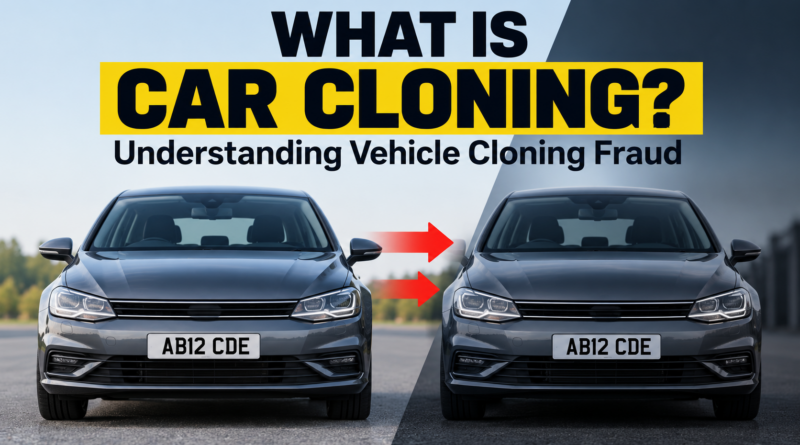
Car cloning, sometimes described as vehicle identity theft, involves using identifying details belonging to one legitimate vehicle on another vehicle.
There are different levels of cloning.
Number plate cloning
This is the simpler version.
Someone obtains or copies the registration number belonging to a legitimate vehicle and puts matching plates onto another car.
The cloned vehicle will often be a similar make, model and colour because this makes the false registration less obvious.
The genuine registered keeper might know absolutely nothing about it until something unexpected arrives through the post.
That could be a:
- Parking charge
- Penalty Charge Notice
- Clean Air Zone charge
- Congestion or road-user charge
- Speeding allegation
- Police enquiry
RAC’s September 2026 guidance similarly notes that owners may not realise their registration has been cloned until they receive a fine for an offence they did not commit or, in more serious circumstances, are contacted by police.
Full vehicle identity cloning
This is more concerning for used-car buyers.
Instead of copying only the registration plate, criminals may attempt to make another vehicle appear to have the identity of a genuine one.
That can potentially involve:
- False registration plates
- False or fraudulently obtained paperwork
- Altered VIN information
- Changed labels or identification markings
- Matching the cloned vehicle to the make, model and colour of the genuine car
RAC warns that criminals attempting to sell a cloned vehicle may produce false V5C documentation and could alter VIN information.
This is why checking the registration online isn’t enough by itself.
What Is a VIN and Why Is It So Important?
VIN stands for Vehicle Identification Number.
Think of it as the vehicle’s identifying number rather than its registration plate.
Registration numbers can change during a vehicle’s life, for example when personalised registrations are assigned or removed.
The VIN is much more fundamental to the vehicle’s identity.
GOV.UK confirms that the V5C includes vehicle information such as the make and VIN, while DVLA may inspect vehicles where identity needs to be established.
Depending on the vehicle, VIN information may be found in locations such as:
- Visible through the windscreen
- Manufacturer identification label
- Body or chassis stamping
- Door aperture or pillar area
- Engine compartment
The exact locations vary by manufacturer and model.
That’s important.
I wouldn’t tell buyers that every car must have its VIN in one universal set of locations because they don’t.
Why Checking Only the Number Plate Can Be Dangerous
Let’s imagine you’re looking at a stolen vehicle carrying the identity of another legitimate car.
You type the registration into an online MOT checker.
It comes back:
BMW 320d. Black. MOT valid.
The car in front of you is also:
BMW 320d. Black.
Looks reassuring.
But what have you actually proved?
You’ve proved that the registration number you’ve entered corresponds with those recorded details.
You haven’t necessarily established that the physical BMW standing in front of you is the vehicle those records belong to.
That’s why identity verification matters.
GOV UK tells used-car buyers to see the V5C, check that the information provided matches DVLA’s records, review the MOT history and check that the log book isn’t associated with a stolen vehicle.
Those are starting points.
I then want the physical car to support that identity.
How I Check a Vehicle’s Identity During an Inspection
When carrying out a vehicle inspection, I’m not interested in one number in isolation.
I’m looking for consistency.
Depending on the vehicle and level of inspection, I may compare:
- Registration number
- VIN visible on the vehicle
- VIN on the V5C
- Manufacturer identification information
- Make and model
- Colour
- Engine and specification information
- Current mileage
- MOT mileage history
- Service history
- Vehicle history information
If those things agree, that’s reassuring.
If they don’t, I stop and investigate.
A discrepancy doesn’t automatically prove cloning.
Cars can have legitimate replacement components. Registration numbers can change. Documentation can contain errors. Vehicles can be modified.
But unexplained identity discrepancies aren’t something I would ignore.
Warning Signs That Deserve Further Investigation
There isn’t one magic clue that identifies every cloned vehicle.
You build a picture.
Warning signs can include:
- VIN doesn’t match the V5C
- Identification markings appear altered or disturbed
- Seller won’t show the original V5C
- Vehicle details don’t agree with DVLA records
- Mileage doesn’t fit the documented history
- Specification doesn’t match the recorded vehicle
- Unusual discrepancies between paperwork and physical car
- Seller refuses reasonable identity checks
- Seller is rushing the transaction
- Price is unusually low without a convincing explanation
- Seller wants payment somewhere unrelated to their claimed address
- Documentation contains inconsistencies
One clue alone might have an innocent explanation.
Several unexplained inconsistencies are different.
The V5C Is Important, But Don’t Misunderstand It
A common mistake is saying:
“He’s got the log book, so he must own the car.”
That’s not what the V5C proves.
It identifies the vehicle’s registered keeper and contains important vehicle information. It is not, by itself, conclusive proof of legal ownership.
When buying, check the document carefully and make sure its vehicle details agree with what is physically in front of you.
GOV.UK specifically advises buyers to see the V5C before buying and check the vehicle against DVLA information.
I’d be extremely cautious if a seller says:
“The log book is lost, but I’ll send it later.”
There can be legitimate reasons for a missing V5C, but why take unnecessary identity risk?
Do the checks before handing over the money.
Protect Your Own V5C From Being Used for Fraud
There’s another side to cloning that owners should know about.
Be careful about posting photographs of your complete V5C online or casually sending copies to strangers.
GOV.UK specifically warns sellers not to share the V5C document reference number or photographs/copies of the log book, because the information could be used to obtain a fraudulent copy and put the vehicle at risk of theft or cloning.
That’s current, practical advice worth remembering.
You can allow a genuine prospective buyer to examine the appropriate document when viewing the vehicle.
That doesn’t mean you should upload a full photograph of it to a public advert.
Use MOT History as Another Identity Check
MOT history isn’t designed specifically as an anti-cloning tool, but I still use it as part of the wider investigation.
Look at the mileage progression.
For example:
- 2022: 28,100 miles
- 2023: 35,900 miles
- 2024: 43,700 miles
- 2025: 51,200 miles
- Car advertised today: 34,000 miles
Something needs explaining.
A mileage discrepancy doesn’t automatically prove cloning. There can be data-entry errors, instrument-cluster replacements and other legitimate explanations.
But you investigate.
I also look at previous MOT defects.
Do they make sense compared with the physical vehicle?
You’re trying to determine whether the documentary history and the car you’re inspecting appear to belong together.
Service History Can Provide More Clues
Service records add another timeline.
Check:
- VIN where recorded
- Registration
- Dates
- Mileage
- Dealer or garage details
- Vehicle specification
- Previous registration numbers where relevant
Again, you’re looking for consistency.
Suppose the MOT history, digital service history, V5C and current vehicle all contain compatible information.
That’s useful supporting evidence.
Suppose they tell four different stories.
That’s when I become much more cautious.
Run a Proper Car History Check
A commercial car history check adds another layer of due diligence.
Depending on the provider and available data, a comprehensive report may help investigate:
- Recorded stolen status
- Outstanding finance
- Insurance write-off history
- Mileage discrepancies
- Registration changes
- Vehicle identity information
CarExamer’s vehicle-history service is designed to help buyers investigate recorded information before committing to a vehicle.
But here’s the important inspector’s point:
A clean history report does not physically authenticate the vehicle in front of you.
You still need to compare the report with the actual vehicle.
History tells you what is recorded against an identity.
Inspection helps establish whether that identity appears to belong to the physical car you’re buying.
Check the Seller as Well as the Vehicle
Identity checks shouldn’t stop at the car.
If buying privately, I want to understand who is selling it and why.
Ask:
- How long have you owned it?
- Why are you selling?
- Is the V5C available?
- Is the vehicle registered to you?
- Is there outstanding finance?
- Where has it been serviced?
- How many keys are present?
- Can I inspect the VIN?
- Can I arrange an independent inspection?
Be particularly careful when the circumstances don’t make sense.
For example, a private seller who wants to meet in a random car park and gives a complicated explanation for why the V5C is in somebody else’s name deserves additional scrutiny.
That doesn’t automatically prove fraud.
But you don’t need to prove fraud before deciding not to hand somebody thousands of pounds.
A Cheap Car Can Become an Extremely Expensive Mistake
Cloned vehicles can be attractive because criminals need buyers.
A car priced noticeably below comparable vehicles naturally attracts attention.
There are legitimate bargains.
People need quick sales. Cars have faults. Sellers price badly.
So a low price alone doesn’t prove anything.
But combine a suspiciously low price with:
- Missing paperwork
- Pressure for immediate payment
- Identity inconsistencies
- Refusal of inspection
- Strange meeting location
- VIN concerns
and I wouldn’t allow the discount to distract me from the risk.
The most expensive car you buy can be the one you don’t legally get to keep.
What Happens If You Unknowingly Buy a Cloned Car?
This is where cloning becomes financially devastating.
You may have paid thousands of pounds believing the seller had legitimate title to the vehicle.
If the car is subsequently identified as stolen, simply buying it innocently does not necessarily mean you obtain good legal title to stolen property.
The circumstances can become complicated very quickly.
You could potentially face:
- Loss of the vehicle
- Loss of the purchase money
- Insurance complications
- Police involvement
- A dispute with the seller
- Difficulty tracing the person who sold it
That’s why prevention is so much better than trying to sort the situation out afterwards.
If you suspect you’ve bought a stolen or cloned vehicle, don’t attempt to resolve matters by confronting somebody you believe may be involved in criminal activity. Contact the police and obtain appropriate advice.
What If My Genuine Car Has Been Cloned?
This is a different scenario.
Your car is genuine and still sitting on your driveway.
But somebody else is driving another vehicle using your registration.
You may first discover it when an enforcement notice arrives for somewhere you weren’t.
Don’t simply pay it because the registration matches yours.
Gather evidence.
Depending on the circumstances, useful evidence might include:
- Photographs of your vehicle
- Distinguishing features
- Location evidence
- Receipts
- Work records
- CCTV or dashcam footage where legitimately available
- Differences between your car and the vehicle shown in enforcement photographs
Report suspected cloning to the police and follow the dispute procedure provided by whichever authority or organisation issued the notice.
RAC’s current guidance likewise advises victims to contact the police and the DVLA and to challenge fines or charges they did not incur, providing evidence where possible.
Protecting Your Car From Being Cloned
You can’t completely prevent somebody from seeing your registration number. It has to be displayed on the road.
But you can avoid unnecessarily publishing sensitive documentation.
In particular:
- Don’t publicly upload your full V5C
- Don’t share its document reference number
- Be cautious about sending complete V5C photographs
- Keep vehicle documentation secure
- Investigate unexpected fines promptly
- Report stolen registration plates
GOV.UK’s warning about protecting V5C information is particularly important because fraudulent copies can put a vehicle at risk of theft or cloning.
Why a Vehicle Inspection Helps When Buying Used
A professional inspection cannot guarantee that every sophisticated identity fraud will be discovered.
That would be an irresponsible promise.
But identity verification should form part of sensible used-car due diligence.
During a CarExamer-style vehicle inspection, the objective isn’t simply to check whether the engine sounds healthy.
You’re building a picture from:
- Physical condition
- VIN information
- Documentation
- Mileage
- MOT history
- Service records
- Diagnostics where appropriate
- Bodywork
- Mechanical condition
- Seller information
When those elements agree, confidence increases.
When they don’t, you investigate before purchasing.
That’s how an inspection should work.
Not:
“The registration came back clean, so the car must be fine.”
My Anti-Cloning Checklist Before Buying a Used Car
Before handing over money, I recommend checking:
- Does the registration match the vehicle?
- Does the VIN on the vehicle match the V5C?
- Do accessible VIN/identity markings appear consistent?
- Do make, model, colour and specification make sense?
- Does the seller have the V5C?
- Do the V5C details agree with DVLA information?
- Does MOT mileage progress logically?
- Does service history support the vehicle’s identity and mileage?
- Has an appropriate vehicle history check been completed?
- Is there a recorded stolen marker?
- Is there outstanding finance?
- Does the seller’s story make sense?
- Are there unexplained identity discrepancies?
- Is the seller comfortable with reasonable checks?
- Would an independent inspection be sensible?
GOV.UK’s official buying process similarly tells buyers to check DVLA details, MOT history, recalls and the V5C before purchasing.
Final Thoughts
Car cloning works because buyers naturally trust familiar things.
A registration number.
An MOT history.
A V5C.
A car that looks exactly like the model shown on the records.
But none of those should be considered completely in isolation.
As an inspector, I want the physical vehicle and documentary identity to agree.
Check the VIN.
Check the V5C.
Check DVLA information.
Read the MOT history.
Review the service history.
Run an appropriate history check.
Check the seller.
And if the value of the vehicle justifies it, consider an independent car inspection before completing the purchase.
Most importantly, don’t let an attractive price or seller pressure persuade you to ignore an identity discrepancy.
A mechanical problem might cost you £1,000 to repair.
Buying a stolen vehicle disguised with another car’s identity can potentially leave you without the car and without the money you paid for it.
The best time to discover that something doesn’t add up is before you buy.