What Does the Arrow Next to Your Fuel Gauge Mean?
Have you ever pulled into a petrol station in an unfamiliar car and suddenly realised you don’t know which side the fuel cap is on?
It’s a common situation, particularly when driving a hire car, a recently purchased vehicle or a family member’s car. You approach the pump, make a quick guess and sometimes end up on the wrong side.
Fortunately, many cars have a small dashboard feature that solves this problem.
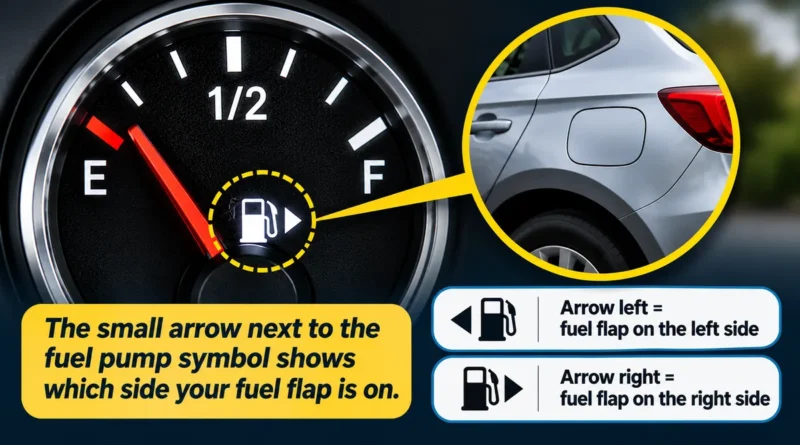
The little arrow next to the fuel pump symbol tells you which side of the car the fuel filler flap is located.
If the arrow points left, the fuel flap is on the left. If it points right, the flap is on the right.
It’s a simple feature, but plenty of drivers overlook it.
As a professional car inspector, I spend time examining vehicle controls, dashboard instruments and warning lights. Understanding these details is useful because not every symbol means what drivers initially assume.
In this guide, I’ll explain how the fuel gauge arrow works, what to do if your car doesn’t have one, and what other fuel gauge information you should understand.
What Is the Small Arrow Next to the Fuel Gauge?
The fuel gauge arrow is a small triangular indicator displayed beside the fuel pump symbol on many vehicle dashboards.
Its purpose is to identify the location of the fuel filler flap.
The direction is based on the vehicle’s left and right sides when facing forwards from the driver’s seat.
| Arrow direction | Fuel flap location |
|---|---|
| ◀ Left | Left-hand side of the car |
| Right ▶ | Right-hand side of the car |
For example, if you’re driving a car with a right-pointing arrow, the fuel flap should be on the right-hand side of the vehicle.
You don’t need to get out and check before choosing a pump.
Ford’s owner manuals explicitly explain that the arrow beside the fuel pump symbol identifies the side of the fuel filler. The same feature is documented by Jaguar Land Rover and Volvo.
Where Can You Find the Fuel Cap Arrow?
On most vehicles equipped with the feature, the arrow is positioned beside the small fuel pump icon.
You may find it:
- Next to the fuel gauge needle
- Beside the fuel level bars
- On a digital instrument cluster
- Near the estimated remaining driving range
- Within the driver’s information display
The position varies between manufacturers.
On older cars, the symbol may be printed permanently on the instrument panel.
On newer vehicles, it may appear as part of a digital display.
Some cars show the fuel pump symbol and arrow together, while others position the arrow slightly apart from the icon.
Look carefully because the triangle can be surprisingly small.
Does Every Car Have a Fuel Gauge Arrow?
No. Not every vehicle has this feature.
Some older cars and certain modern models display a fuel pump symbol without a separate directional arrow.
Others may use a different dashboard layout or show the fuel filler location elsewhere in the driver’s display.
If your car doesn’t have an arrow, don’t assume the fuel flap is on a particular side.
You can check by:
- Looking at the exterior of the vehicle
- Consulting the owner’s manual
- Checking the manufacturer’s refuelling instructions
- Looking for a fuel filler release control, where fitted
Once you’ve identified the correct side, it’s worth remembering it for future visits to the petrol station.
Does the Fuel Pump Hose Symbol Show Which Side the Cap Is On?
This is one of the most common misunderstandings.
Some drivers believe the position of the hose on the fuel pump picture indicates the side of the car containing the fuel flap.
For example, they assume a pump icon with the hose on the right means the filler must be on the right.
That isn’t a reliable rule.
The hose is part of the fuel pump illustration. Unless the vehicle manufacturer specifically states otherwise, it shouldn’t be used as a directional indicator.
The small triangle or arrow is the feature designed to show the fuel filler location.
If there’s no arrow, check the actual vehicle rather than guessing from the pump icon.
Why Is the Fuel Flap on Different Sides of Different Cars?
There is no universal rule requiring all cars sold in the UK to have the fuel filler on the same side.
Its location depends on the manufacturer’s design and engineering decisions.
Factors may include:
- Fuel tank position
- Filler pipe routing
- Body structure
- Packaging around the rear suspension
- Exhaust system layout
- Crash protection requirements
- Shared vehicle platforms
Some manufacturers commonly place the fuel filler on one side across several models, but there can be exceptions.
The location also doesn’t necessarily change simply because a vehicle is built for a right-hand-drive market.
For this reason, don’t assume that a Japanese, German, French or British car will always have its fuel flap on a particular side.
The arrow is much more useful than the manufacturer’s country of origin.
How to Use the Fuel Gauge Arrow at a Petrol Station
Using the arrow takes only a few seconds.
- Before entering the filling station, look at the fuel pump symbol on your dashboard.
- Find the small arrow or triangle beside it.
- Identify whether it points left or right.
- Choose a pump position that gives you convenient access to the filler.
- Park safely, switch off the engine and follow the vehicle’s refuelling instructions.
For example, if the arrow points left, positioning the left side of the car nearest the pump is usually the most convenient choice.
Some filling station hoses are long enough to reach around a vehicle, but that doesn’t mean stretching a hose across the bodywork is always advisable.
Avoid dragging the hose against painted panels or creating an obstruction.
What Does the Fuel Gauge Actually Tell You?
The fuel gauge estimates how much fuel remains in the tank.
Traditional gauges use a needle moving between empty and full markings.
Modern digital displays may use illuminated bars or a graphical representation of the tank.
Common markings include:
- E: Empty
- F: Full
- 1/2: Approximately half a tank
- Fuel pump symbol: Fuel level or refuelling information
- Small directional arrow: Fuel filler side
The fuel gauge is an approximate indicator rather than a laboratory-accurate measurement.
Fuel moves inside the tank during acceleration, braking and cornering.
Vehicle manufacturers use sensor systems and electronic processing to provide a reasonably stable reading.
However, the indicated level can still vary slightly, particularly when the car is parked on a slope.
Ford’s technical guidance confirms that fuel gauge readings may change with vehicle movement and gradients.
What Does the Low Fuel Warning Light Mean?
The low fuel warning usually appears as an illuminated fuel pump symbol.
It tells you that the amount of fuel remaining has fallen below a manufacturer-defined threshold.
The precise amount varies between vehicles.
There is no universal rule that the warning always means you have exactly five litres or 30 miles remaining.
Some vehicles also display an estimated distance to empty.
However, this figure is only an estimate.
It can change depending on:
- Driving speed
- Traffic conditions
- Acceleration
- Road gradients
- Vehicle load
- Fuel consumption
- Recent driving behaviour
If you’ve been driving steadily on a motorway and then enter heavy city traffic, the estimated remaining range may fall more quickly.
Don’t treat the displayed distance as a guarantee.
Is It Bad to Drive With Very Little Fuel?
Regularly running a car extremely low on fuel isn’t a good habit.
On many modern vehicles, the fuel pump is located inside the tank and is designed to operate with fuel passing through or around its components.
Allowing the tank to run dry can cause the engine to stop and may create additional problems.
Diesel vehicles can be particularly inconvenient to restart after running out of fuel because some systems require a specific priming procedure.
There is also the obvious safety issue of breaking down unexpectedly.
My recommendation is to refuel before the gauge approaches empty, especially before long journeys or when travelling through areas with limited filling stations.
What If the Fuel Gauge Is Showing the Wrong Reading?
A faulty fuel gauge can be more than a minor inconvenience.
If it indicates that fuel remains when the tank is nearly empty, you could run out unexpectedly.
Possible causes include:
- Faulty fuel level sender
- Damaged or worn float mechanism
- Electrical wiring problems
- Instrument cluster faults
- Fuel tank sensor problems
- Software or communication faults
Symptoms may include a gauge stuck on full, a reading that never rises after refuelling or a display that changes unpredictably.
Some variation immediately after filling is normal, depending on the vehicle.
However, repeated or substantial inaccuracies deserve investigation.
As a car inspector, I would assess the symptoms alongside other dashboard information and diagnostic findings before recommending further testing.
Replacing components without confirming the fault can become expensive.
What Is a Fuel Level Sender?
The fuel level sender is the component that measures the approximate amount of fuel inside the tank.
Many conventional systems use a float connected to a variable electrical resistance.
As the fuel level rises or falls, the float moves and the sender provides a changing signal.
The vehicle then uses that signal to display the fuel level.
Some modern systems use different sensor arrangements or more than one sender, particularly where the fuel tank has an unusual shape.
A worn sender can produce inaccurate or intermittent readings.
However, a faulty gauge doesn’t automatically mean the sender is defective.
Wiring, control modules and instrument displays can also cause problems.
How to Open the Fuel Filler Flap
Once you’ve found the correct side, you still need to know how the flap opens.
Different cars use different mechanisms.
Common designs include:
- A flap that opens when pressed
- A release lever inside the cabin
- A dashboard release button
- A flap linked to the central locking system
- A manually opened flap with a locking fuel cap
Some plug-in hybrids also have pressurised fuel systems that require the driver to activate a release control before opening the flap.
For example, Volvo documents a system in which the driver presses a button and waits for the tank pressure to equalise before refuelling.
If the flap doesn’t open immediately, don’t force it.
Check whether the vehicle is locked or whether a release procedure is required.
Check the Correct Fuel Before Filling Up
Knowing which side the fuel flap is on is useful, but choosing the correct fuel is far more important.
Always confirm whether the vehicle requires petrol or diesel.
For petrol vehicles, check whether the manufacturer approves E10 fuel or specifies another grade.
For diesel vehicles, follow the manufacturer’s fuel requirements.
The correct fuel information may be displayed:
- Inside the fuel filler flap
- On the fuel cap
- In the owner’s manual
- In the vehicle’s digital handbook
Never assume the fuel type from the model badge alone.
Some models have been sold with petrol, diesel and hybrid powertrains.
If you accidentally put the wrong fuel into your car, do not start the engine or switch on the ignition unnecessarily. Follow specialist misfuelling recovery advice.
Starting the engine may circulate the incorrect fuel through the system and increase the repair costs.
Why Dashboard Symbols Matter When Buying a Used Car
The fuel filler arrow itself is a convenience feature, not a warning sign.
However, understanding the instrument cluster is important when buying a used vehicle.
During a professional inspection, dashboard checks can help identify concerns involving:
- Engine management warnings
- ABS and braking systems
- Airbag warnings
- Charging system faults
- Coolant temperature warnings
- Fuel level information
- Instrument display operation
Warning lights should normally illuminate and extinguish according to the manufacturer’s self-check procedure.
A missing warning light, an illuminated fault indicator or an instrument display that doesn’t behave correctly may require further investigation.
A professional vehicle inspection can help assess the vehicle’s overall condition, including relevant dashboard warnings and electronic systems, depending on the inspection package.
The fuel gauge arrow won’t tell you whether a car is mechanically healthy, but learning what the dashboard displays mean can help you recognise problems before they become expensive.