What Is Car Service History? What to Check Before Buying a Used Car
When I’m inspecting a used car, there is normally a point when I ask the seller:
“Can I see the service history?”
Sometimes I’m handed a folder full of invoices going back years. Other times there is a service book containing a few stamps and not much else.
Then you get:
“It’s all digital.”
That’s fine too, provided somebody can actually show me the digital record.
What I don’t do is see the words “Full Service History” in an advert and automatically assume I’m looking at a well-maintained car.
Service history is evidence. Good evidence can tell you a great deal about how a car has been maintained, how regularly it has visited a garage and whether important jobs appear to have been completed.
But it isn’t a guarantee of the car’s current condition.
That’s why, when buying used, I look at the service history alongside the MOT record, vehicle history, invoices and the physical condition of the car.
They should all tell roughly the same story.
What Is Car Service History?
A car service history is the documented record of servicing and maintenance carried out during the vehicle’s life.
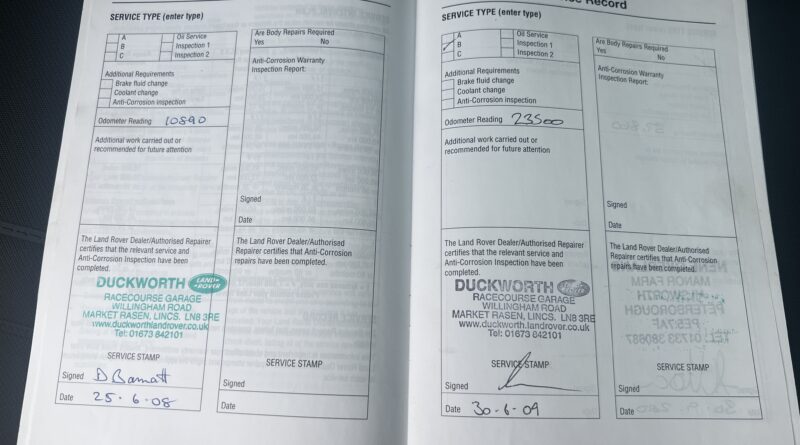
Traditionally, this meant a paper service book supplied with the car when it was new. Every time the vehicle was serviced, the garage entered the date and mileage and stamped the book.
Things have changed.
Depending on the vehicle, service evidence can now include:
- A traditional stamped service book
- Digital manufacturer service records
- Main dealer records
- Independent garage records
- Itemised invoices
- Parts receipts
- Maintenance printouts
- Specialist workshop records
RAC’s current guidance similarly describes service history as the record of work carried out on a vehicle and recommends keeping itemised receipts showing the date, mileage, work performed, who completed it and any parts replaced.
For me, invoices can be particularly useful because they tell me much more than a stamp.
A stamp says the car visited a garage.
An invoice can tell me what the garage actually did.
Why Does Service History Matter When Buying Used?
You’re trying to answer a simple question:
How has this car been looked after before I arrived?
You can’t travel backwards in time and watch the previous owner maintain it.
Service records give you evidence.
Depending on the vehicle, they might show routine work such as:
- Engine oil and filter changes
- Air and fuel filters
- Spark plugs
- Brake fluid
- Coolant
- Gearbox servicing
- Differential servicing
- Timing belt replacement
- Auxiliary belts
- Brake replacement
- Suspension repairs
- Battery replacement
- Other mechanical repairs
That information becomes particularly important when expensive scheduled maintenance should already have been completed.
If I’m buying a car with a timing belt, for example, I want to know what the manufacturer specifies for that particular engine and whether there is evidence of replacement where it should already have happened.
“The previous owner definitely did it” isn’t evidence.
An invoice is much better.
What Does Full Service History Actually Mean?
You’ll frequently see FSH in used-car adverts.
It stands for Full Service History.
In practical terms, I expect a seller making that claim to be able to demonstrate a continuous maintenance record broadly consistent with the manufacturer’s servicing requirements for that particular vehicle.
But don’t just accept the abbreviation.
Ask to see the history.
CarExamer’s current used-car guidance recommends looking for a full service history as part of the initial screening process, together with evidence such as recent servicing and relevant maintenance. It also recommends checking the MOT record for previous problems that may indicate poor maintenance.
If a seller advertises a car as having FSH but cannot produce the records, I would want that explained before treating the claim as established.
Full Dealer Service History Is Slightly Different
You may also see:
Full Main Dealer Service History
or sometimes:
FDSH
This generally means the servicing has been completed within the manufacturer’s franchised dealer network.
That can be desirable, particularly on newer, premium, specialist and performance vehicles.
But I don’t automatically assume that a main dealer stamp makes a car mechanically superior to one maintained by a good independent specialist.
An experienced independent garage may maintain a vehicle extremely well.
What I’m interested in is:
- Was the car serviced at the required intervals?
- Was the correct work completed?
- Were suitable parts and fluids used?
- Is there supporting evidence?
- Were important manufacturer-specific maintenance items completed?
- Does the current condition support the maintenance story?
The garage name matters less to me than the quality, timing and evidence of the maintenance.
What Is Partial Service History?
Partial service history means some maintenance records are available but parts of the history are missing.
Maybe you have records for the first four years, nothing for the next two, and invoices from an independent garage afterwards.
That isn’t automatically disastrous.
Cars change owners.
Service books get lost.
Garages close.
Some records move from paper to digital systems.
But missing history introduces uncertainty.
The important question is what is missing.
One missing routine service on an older inexpensive car is different from several undocumented years on an expensive performance vehicle where major scheduled work should have occurred.
I treat the size and importance of the gap in context.
Don’t Confuse Service History With MOT History
I see this surprisingly often.
The seller says:
“It’s been MOT’d every year, so it’s obviously been serviced.”
No.
An MOT and a service are not the same thing.
CarExamer’s current MOT guidance makes the distinction clearly: MOT history records tests, while service history documents maintenance. MOT records do not provide a complete account of oil changes, timing-belt work, servicing or every repair carried out.
That doesn’t mean MOT history isn’t useful.
It is extremely useful.
I read previous tests in sequence and look for patterns.
For example:
- Repeated tyre advisories
- Recurring oil leaks
- Suspension defects
- Brake problems
- Corrosion
- Repeated failures
- Mileage inconsistencies
Then I compare those findings with the service invoices.
If the MOT repeatedly identifies the same problem and there is no evidence it was properly addressed, I want to know why.
Compare the Service Mileage With the MOT Mileage
This is one of the simplest checks you can make.
Imagine the service history says:
- 2021: 24,500 miles
- 2022: 33,200 miles
- 2023: 41,700 miles
- 2024: 50,100 miles
- 2025: 44,300 miles
That last entry deserves investigation.
It might be nothing more than a garage typing error.
But I wouldn’t simply ignore it.
CarExamer recommends comparing MOT mileage with the advert, dashboard reading and service records. It also correctly points out that even a consistent mileage sequence doesn’t guarantee that every mile travelled is genuine.
I want the MOT record, service history and odometer to form a believable timeline.
Dates Matter Just as Much as Mileage
Buyers often focus entirely on miles.
Imagine somebody owns a performance car that has covered only 2,000 miles in the last two years.
They might tell you:
“It hasn’t done enough miles to need servicing.”
That may or may not be correct.
It depends on the manufacturer’s requirements.
Some maintenance is based on mileage, some on time, and some servicing regimes consider both.
That’s why I don’t recommend following a generic internet rule such as “every car needs servicing at exactly X miles”.
Check the manufacturer’s schedule for the specific make, model, engine and age.
That’s the benchmark that matters.
Look Beyond the Word “Service”
Suppose a car has been serviced every year for eight years.
Excellent.
Now I want to know what those services actually included.
Depending on the vehicle, there may have been additional maintenance requirements involving:
- Timing belt
- Water pump
- Spark plugs
- Brake fluid
- Coolant
- Transmission oil
- Differential oil
- Fuel filter
- Auxiliary belt
- Specialist filters
This is where invoices become extremely valuable.
A service stamp might simply say:
“Service, 62,400 miles.”
An invoice could tell me the engine oil specification, filters replaced, brake condition, additional repairs and whether a major scheduled job was completed.
When I’m spending thousands of pounds on a used car, I prefer the second version.
Don’t Automatically Be Frightened by a Thick Repair Folder
This needs some common sense.
Some buyers see a pile of repair invoices and think:
“This car has had loads of problems.”
I sometimes see the opposite.
I see evidence that somebody actually spent money looking after the vehicle.
Suppose the previous owner has replaced:
- Suspension arms
- Brakes
- Battery
- Air-conditioning condenser
- Four quality tyres
Those invoices aren’t automatically bad news.
Some of those components wear out.
I’d rather see documented evidence that necessary work was completed than a car where problems were ignored to save money.
What interests me more is a repeated unresolved fault.
If I see three invoices relating to the same electrical problem and it is still malfunctioning during my inspection, that’s different.
Digital Service History Is Normal on Modern Cars
Don’t assume a car has no service history simply because there isn’t a paper book in the glovebox.
Many modern vehicles use electronic records. Here is example of the Range Rover digital service history.
RAC notes that garages and manufacturers may store service information digitally and that owners may be able to recover missing information by contacting the manufacturer, franchised dealer or garage that completed previous work.
If the seller tells me:
“It’s all digital.”
My response is simple:
“Can you show me?”
Depending on the manufacturer, evidence might be provided as a printout, electronic record or dealer-generated service report.
What I don’t accept as proof is:
“It’s definitely on the system somewhere.”
Can Missing Service History Be Recovered?
Sometimes, yes.
If a service book has disappeared, investigate before assuming the records are permanently lost.
You may be able to contact:
- The manufacturer
- Main dealer network
- Independent garages shown on old invoices
- Previous servicing specialists
- The previous owner, where appropriate and possible
RAC notes that manufacturers, dealerships and garages may retain records, although access requirements can vary and proof that you own the vehicle may be required.
If you’re still considering the car, it’s worth doing some detective work.
Turning a vague claim of “part history” into documented servicing can materially change how I assess the vehicle.
How I Check Whether Service History Looks Genuine
I don’t assume that something is genuine simply because there’s a stamp on a piece of paper.
I look at the record as a whole.
I ask:
- Do the dates progress logically?
- Do the mileages make sense?
- Are servicing intervals appropriate?
- Do invoices support important entries?
- Does the registration match?
- Does the VIN match where recorded?
- Do the garage details make sense?
- Does the MOT mileage support the service history?
- Can major maintenance be verified?
If something important doesn’t make sense, investigate it.
That might mean contacting the garage shown on an invoice or asking a manufacturer or specialist for further records.
The objective isn’t to catch somebody out.
It’s to establish what you’re actually buying.
Service History and Vehicle History Are Not the Same Thing
This distinction is important.
Service history tells you about maintenance and repairs.
A vehicle history check investigates recorded information about other aspects of the vehicle’s background.
CarExamer’s full history check, for example, can investigate available records concerning finance, theft, insurance write-offs, mileage and vehicle identity.
RAC also recommends combining service-history review with a broader vehicle-history check and physical checks when buying used car.
One doesn’t replace the other.
A car can have an immaculate service history and outstanding finance.
It can have a clear history report and poor maintenance.
And it can have both good histories while still having a mechanical fault today.
That’s why you build the complete picture.
Service History Does Not Prove Current Condition
This is probably the most important point I can make as an inspector.
A full service history does not guarantee that a used car is mechanically good today.
CarExamer explicitly warns that recorded history and seller information do not guarantee future reliability or replace physical inspection.
I’ve seen cars with paperwork that looked excellent but the vehicle itself told a different story.
A service book may not reveal today’s:
- Oil leak
- Worn clutch
- Suspension knock
- Wheel-bearing noise
- Brake wear
- Damaged tyre
- Air-conditioning fault
- Poor accident repair
- Corrosion
- Diagnostic fault
- Water ingress
The paperwork tells me what has been recorded.
A vehicle inspection tells me what condition the car appears to be in now.
That’s why I want both.
CarExamer’s inspection packages themselves include service-history checks alongside mechanical, electrical, bodywork, VIN, diagnostic and other physical checks, depending on the inspection level selected.
What About a Car With No Service History?
No service history doesn’t automatically mean no servicing took place.
But it means you have less evidence.
That increases uncertainty.
How much that matters depends on what you’re buying.
An inexpensive 15-year-old runaround can be assessed differently from a three-year-old performance car costing £50,000.
If I’m inspecting a car with no history, I want to establish:
- What maintenance should already have been completed?
- Is any of it independently verifiable?
- Is major maintenance now due?
- What does the MOT history show?
- Does the mileage make sense?
- What condition is the engine in?
- Are there fluid leaks?
- How does the transmission behave?
- What condition are the brakes and suspension in?
- Are there warning lights or diagnostic faults?
- Does the road test reveal anything concerning?
Missing paperwork doesn’t automatically make the car bad.
It means I have fewer facts and therefore more uncertainty.
The price and buying decision should reflect that.
Does Service History Affect a Used Car’s Value?
It can.
RAC notes that a complete service record can help demonstrate that a vehicle has been cared for and may support its value when it is eventually sold.
That makes practical sense.
Imagine two otherwise similar cars.
Car A has organised invoices, consistent servicing, documented major maintenance and records that agree with its MOT history.
Car B has nothing except the seller saying:
“My mate used to service it.”
Car A gives me more evidence.
That doesn’t automatically make it mechanically better, but it reduces one area of uncertainty.
Service history becomes particularly important on premium, specialist and performance cars where missing maintenance evidence can affect buyer confidence and future resale.
My Used-Car Service History Checklist
Before buying, I recommend working through the following:
- Ask whether the history is full, partial or missing.
- Ask to see the evidence rather than relying on the advert.
- Check whether records are paper, digital or both.
- Compare service dates and mileages.
- Compare those mileages with the MOT record.
- Check servicing against the manufacturer’s schedule.
- Look for evidence of major maintenance.
- Read invoices, not just service-book stamps.
- Investigate repeated faults.
- Check whether missing records can be recovered.
- Run an appropriate vehicle history check.
- Inspect the physical condition of the car.
- Road test it where appropriate.
- Resolve important discrepancies before paying a deposit or completing the purchase.
CarExamer’s current guidance follows the same evidence-based principle: use recorded information to prepare questions for the seller, compare the history with the actual car and arrange an appropriate inspection when you need to establish its present condition.
The Four Stories I Want to Agree
When I’m inspecting a used car, I normally have four versions of its life in front of me.
There’s the seller’s story.
There’s the service history.
There’s the MOT and vehicle-history record.
And then there’s the actual car.
I want them to agree.
If the seller tells me the car has been maintained regardless of cost, I expect the paperwork and physical condition to support that claim.
If the service records show regular maintenance but the MOT history repeatedly mentions neglected tyres, oil leaks and suspension defects, I start asking questions.
If the paperwork looks perfect but the car has an obvious mechanical problem, I trust what the inspection is showing me.
A used car doesn’t become good because it has a folder full of paper.
Final Thoughts
Car service history matters because it gives you something every used-car buyer needs:
Evidence.
It helps you understand how regularly the car was maintained, what work has been documented and whether important scheduled jobs appear to have been completed.
But don’t turn the words “Full Service History” into a guarantee.
Check the dates.
Check the mileage.
Read the invoices.
Compare the records with the manufacturer’s servicing requirements.
Look through the MOT history.
Run an appropriate history check.
Then inspect the actual vehicle.
CarExamer makes the distinction particularly well: MOT records help you investigate previous test results, service history documents maintenance, a history check investigates recorded background risks, and a physical inspection assesses the car’s current condition.
That’s the approach I use as an inspector.
Because when you’re buying a used car, you’re not buying the service book.
You’re buying the car sitting in front of you.