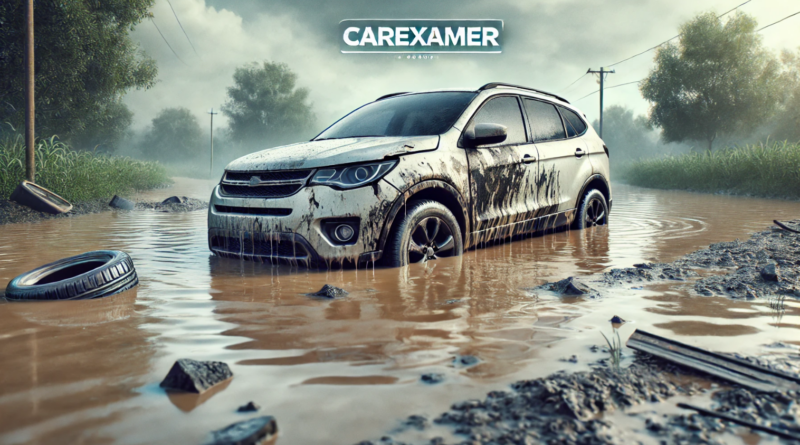
Flood-Damaged Cars: How to Spot One Before You Buy
A shiny used car can hide a surprising amount.
Freshly cleaned seats, polished paintwork and an engine bay covered in dressing can make a car look considerably better than it did a few days earlier. Usually that’s just normal preparation for sale.
But occasionally I inspect a car where something doesn’t add up.
The interior is spotless, yet underneath a seat rail there’s corrosion. The carpets look almost new, but the metal underneath them doesn’t. Electrical equipment behaves strangely. There’s dirt somewhere dirt shouldn’t reasonably be.
Then comes the smell.
Not necessarily a terrible smell. Sometimes it’s just damp. Sometimes there’s an overpowering air freshener trying very hard to make sure you don’t smell anything else.
That’s when I start asking a different question:
Has this car been full of water?
Flood damage is one of those used-car problems I take seriously because water can reach places that are difficult, expensive and sometimes unrealistic to restore properly.
A car that has been standing in deep floodwater can be cleaned until it looks perfectly presentable. What concerns me is what happened underneath the carpets, inside electrical connectors, behind trim panels and within electronic modules.
Those problems may not introduce themselves during a ten-minute viewing.
Why Flood Water and Cars Don’t Mix
Modern cars contain a huge amount of electrical equipment.
Depending on the vehicle, electronic modules, wiring harnesses, connectors and sensors can be located beneath seats, behind interior trim and low down in the body.
If contaminated water reaches these areas, simply drying the car doesn’t necessarily undo the damage.
Corrosion can continue after the visible water has gone.
Floodwater itself can also contain sewage, chemicals, mud and other contamination. UK government flood advice warns that floodwater may contain chemicals or waste, which gives you an idea of what can potentially enter a submerged vehicle. GOV.UK
From an inspection point of view, I’m concerned about several areas.
Electrical systems
Water can reach connectors, wiring and electronic control units.
Problems may include:
- Intermittent warning lights
- Central locking faults
- Electric-window problems
- Seat-control faults
- Parking-sensor problems
- Infotainment failures
- Lighting faults
- Battery drain
- Communication faults between control modules
Intermittent faults are particularly unpleasant because everything might work perfectly during your viewing.
Two weeks later, it might not.
Engine and drivetrain
If an engine takes water into its cylinders while running, serious mechanical damage can occur.
Water doesn’t compress like the normal air-fuel mixture. In severe cases, water ingestion can cause hydrolock and internal engine damage.
Water contamination may also affect oils and other fluids depending on how deeply and for how long the vehicle was submerged.
Interior contamination
Seats and the visible surface of a carpet aren’t my only concern.
Cars have thick carpet underlay, insulation, foam and sound-deadening materials that can retain moisture.
A seller might clean the visible carpet while moisture remains underneath.
That can lead to:
- Damp smells
- Mould
- Staining
- Corrosion
- Condensation
- Electrical problems
Corrosion
This is one of the reasons flood damage worries me long after the car has apparently dried.
Corrosion doesn’t need to announce itself immediately.
Look at electrical terminals, connectors, seat frames, fasteners, brackets and metalwork hidden beneath trim.
A car can be dry today and still carry evidence of where the water has previously been.
Are Flood-Damaged Cars Automatically Category A Write-Offs?
No.
This needs correcting because there is a lot of misleading information online about flood cars and insurance categories.
A Category A vehicle cannot be repaired and must be crushed. A Category B vehicle cannot return to the road as a complete vehicle, although certain parts can be salvaged.
Categories S and N are repairable write-off categories. Category S relates to structural damage, while Category N relates to non-structural damage. A Category S or N vehicle can return to use if repaired to a roadworthy condition. GOV.UK
Therefore:
Flood damage does not automatically mean Category A.
The write-off category depends on the insurer’s assessment and the nature of the damage.
There’s another issue buyers need to understand.
Not every water-damaged car will necessarily have an insurance write-off marker.
For example, if a vehicle wasn’t subject to an insurance claim, you shouldn’t assume a commercial history report will magically know that it spent time in floodwater.
That’s why I use history checks and physical inspection together.
How I Look for Flood Damage During an Inspection
There isn’t one magic test.
I’m looking for a collection of clues.
One slightly rusty bolt doesn’t prove that a car was flooded.
But if I find corrosion under both front seats, suspiciously new carpets, damp underlay, silt behind interior trim and electrical faults, the story becomes much more interesting.
1. Start With the Smell
When I open the door, I pay attention before I’ve touched anything.
A persistent musty or damp smell deserves investigation.
So does the opposite extreme.
If a car smells as though an entire bottle of air freshener has been emptied inside it, I want to know why.
It could be innocent.
The previous owner might simply love artificial vanilla.
But I’m still checking underneath the carpets.
2. Look Under the Carpets, Not Just at Them
A freshly cleaned carpet proves very little.
Where accessible without damaging anything, inspect the edges and areas beneath mats.
I’m looking for:
- Dampness
- Staining
- Mud
- Sand
- Unusual discolouration
- Corrosion
- Evidence that carpets have recently been removed
- Inconsistent or replaced underlay
The boot deserves the same treatment.
Lift the boot floor and inspect the spare-wheel well or lower storage area.
Water and dirt often collect at the lowest points.
3. Check the Seat Rails and Fasteners
Seat rails can provide useful clues because they’re low in the cabin.
Look closely at:
- Seat mounting bolts
- Seat frames
- Rails
- Electrical connectors beneath seats
- Exposed brackets
Heavy or unusual corrosion inside a relatively young, otherwise tidy car makes me ask questions.
Again, corrosion alone doesn’t prove flooding.
You’re building a picture.
4. Look in Places That Are Difficult to Clean
Anybody preparing a questionable car for sale will probably clean the obvious areas.
I’m more interested in the unobvious ones.
Mud or silt in strange locations can be much harder to explain.
Depending on access, I may inspect around:
- Seat bases
- Carpet edges
- Door apertures
- Boot trim
- Spare-wheel well
- Wiring channels
- Low-mounted electrical connectors
- Behind accessible trim
- Under the dashboard
- Engine-bay recesses
Floodwater has a habit of carrying dirt with it.
Cleaning every hidden cavity is much harder than shampooing a seat.
5. Look for a Water Line
Occasionally water leaves a visible level mark.
That might appear as:
- Staining
- A dirt line
- Different corrosion above and below a point
- Marks behind trim
- Discolouration on fabric
A clear water line inside a car would immediately change how I approached the inspection.
6. Ask Why the Interior Looks New
A replacement carpet isn’t proof of flood damage.
Neither are new seats.
But context matters.
If I’m looking at a ten-year-old car with ordinary wear everywhere else, yet the entire carpet appears strangely new, I’ll ask why it was replaced.
There might be a perfectly sensible answer.
Perhaps something was spilled.
Perhaps the original carpet was damaged.
What I don’t do is ignore the inconsistency.
Test Every Electrical Function You Can
This is where patience helps.
Don’t just start the engine, see that there are no warning lights and assume everything electrical is fine.
I work through the equipment.
Depending on the car, that means checking:
- Electric windows
- Central locking
- Mirrors
- Seat adjustment
- Heated seats
- Air conditioning
- Heater blower
- Exterior lighting
- Interior lighting
- Wipers and washers
- Infotainment
- USB ports
- Cameras
- Parking sensors
- Instrument display
- Steering-wheel controls
- Electric boot
- Sunroof
- Driver-assistance equipment
One broken window motor doesn’t mean a car has been flooded.
Several unrelated electrical faults alongside physical evidence of water ingress are a different matter.
Diagnostic Scanning Can Add Another Layer
On modern vehicles, diagnostic equipment can be useful.
I’m interested in fault codes and, particularly, patterns of communication problems between different control units.
But diagnostics need interpreting properly.
A stored fault code isn’t proof of flooding.
Low battery voltage, previous repairs and disconnected components can generate faults too.
The diagnostic scan is evidence, not a verdict.
Check the Engine Bay and Fluids
If I suspect significant water exposure, the mechanical inspection becomes particularly important.
I’d be looking for unusual contamination, corrosion, damaged electrical connections and evidence that components have recently been disturbed or replaced.
A normal-looking engine bay doesn’t clear the car.
Someone can clean an engine bay.
I’m trying to determine whether the condition of different areas of the vehicle makes sense together.
Don’t Forget the Car’s History
Before travelling to inspect a used car, check as much history as possible.
GOV.UK advises used-car buyers to verify the vehicle details against DVLA records, check its MOT history, check for outstanding safety recalls and examine the V5C. GOV.UK
I would also use an appropriate vehicle history check to investigate information such as recorded insurance write-off history, outstanding finance, stolen records and other available provenance data.
If the history says Category S or N, don’t stop at the category letter.
Ask what actually happened.
If the seller knows it was flood-damaged, I’d want that information clearly explained before considering the car.
A Clean History Report Does Not Prove the Car Was Never Flooded
This deserves emphasis.
A commercial history check is extremely useful, but it only reports information available from its underlying data sources.
It isn’t an underwater-car detector.
If water damage wasn’t recorded through a source available to that service, a clean report doesn’t physically inspect the car for you.
I apply the same principle to accident damage.
A vehicle can have body repairs without necessarily having an insurance write-off marker.
History tells me what has been recorded. Inspection tells me what is physically in front of me.
You need both.
What About an MOT Pass?
A current MOT wouldn’t persuade me that suspected flood damage is harmless.
An MOT is an important roadworthiness check, but it isn’t a forensic investigation into the car’s complete history or a guarantee of future reliability.
If I find signs suggesting previous flooding, I investigate those signs regardless of how recently the vehicle passed its MOT.
Why a Vehicle Inspection Matters With Suspected Flood Damage
This is one situation where I wouldn’t recommend relying on photographs and a seller’s description.
A proper vehicle inspection allows the car to be examined as a whole.
For suspected flood damage, I’d want particular attention paid to:
- Interior moisture
- Hidden corrosion
- Electrical systems
- Diagnostic faults
- Wiring and accessible connectors
- Seat rails and floor areas
- Boot and spare-wheel well
- Engine bay
- Vehicle fluids
- Warning lights
- Road-test behaviour
- Previous repairs
Trading Standards guidance also recommends having a used vehicle checked by a qualified engineer if you don’t have the expertise to assess its condition yourself. London Borough of Bromley
That’s where a car inspection can potentially save far more than it costs.
The aim isn’t to make every old car look frightening.
It’s to separate normal age-related wear from evidence that points towards a much bigger problem.
Should You Buy a Flood-Damaged Car?
For an ordinary buyer looking for dependable daily transport, my position is simple.
If I have credible evidence that water has entered deeply into the passenger compartment or submerged significant electrical systems, I would normally walk away.
Not because every previously flooded car must immediately fail.
The problem is uncertainty.
How deep was the water?
Was it fresh water or contaminated floodwater?
How long was the vehicle submerged?
Which modules were underwater?
Was the interior stripped properly?
Were contaminated components replaced?
Was the wiring repaired correctly?
What corrosion is developing where we cannot easily see it?
Unless there is unusually strong documentation and a very good reason to accept that risk, there are normally plenty of other used cars available.
What About Buying One for Parts?
That’s different.
Someone buying a salvage vehicle for dismantling isn’t making the same decision as somebody buying a family car to drive every day.
But insurance write-off categories matter here too.
A Category A vehicle must be crushed in its entirety. Category B vehicles cannot return to the road as complete vehicles, although certain parts may be salvaged. GOV.UK
Don’t buy salvage without understanding exactly what its category permits.
Be Careful With Imported Cars Too
If you’re considering an imported used vehicle, don’t assume a clean-looking UK history tells you everything that happened before UK registration.
Ask for the available foreign documentation and investigate the vehicle’s previous history where possible.
Physical condition becomes even more important where documentary history is incomplete.
Red Flags That Would Make Me Investigate Further
None of these signs individually proves that a car has been flooded, but several together would concern me:
- Persistent musty smell
- Excessive air freshener
- Damp carpets
- Mould
- Water staining
- Silt or mud in hidden areas
- Corrosion underneath seats
- Corroded electrical connectors
- Suspiciously new carpets
- Recently replaced interior components without explanation
- Multiple unrelated electrical faults
- Unexplained warning lights
- Diagnostic communication faults
- Water or dirt in the spare-wheel well
- Seller unwilling to discuss the car’s history
- Vehicle history inconsistent with the seller’s explanation
- A price substantially below comparable vehicles without a convincing reason
The key is pattern recognition.
I’m not trying to turn one rusty screw into a flood-damage diagnosis.
I’m asking whether all the evidence tells a believable story.
Already Bought a Car and Then Found Flood Damage?
First, document what you’ve found.
Don’t immediately dismantle half the vehicle and throw away the evidence.
Take photographs and retain:
- The original advert
- Sales invoice
- Messages with the seller
- Vehicle-history report
- Inspection findings
- Diagnostic reports
- Repair estimates
- Photographs of corrosion, water staining or contamination
Then establish who sold you the vehicle.
Your rights can differ considerably depending on whether you bought from a motor trader or a private seller.
For purchases from a trader, Trading Standards guidance explains that the Consumer Rights Act 2015 requires a vehicle to be of satisfactory quality, fit for purpose and as described, taking the circumstances into account.
Citizens Advice also notes that where a used car is damaged, does not work or doesn’t match its description, the buyer may have rights to a repair, repair costs or some or all of their money back, depending on the circumstances. Citizens Advice
Private purchases generally provide fewer protections, although the vehicle still needs to match its description and other legal considerations apply.
If there’s a significant dispute, obtain appropriate consumer or legal advice rather than relying on an internet article to determine your specific rights.
My Inspector’s Rule for Suspected Flood Cars
When I inspect a used vehicle, I’m trying to make four stories agree:
- The seller’s story
- The paperwork and history
- The diagnostic information
- The physical condition
If the seller says the car has never had any problems, the history looks clean, but I’m finding damp insulation, silt underneath trim, corroded connectors and multiple electrical faults, I don’t ignore the physical evidence because the computer says “clear”.
Equally, I don’t accuse a seller of hiding flood damage because I find one damp carpet.
I investigate.
That’s what a proper inspection is supposed to do.
Final Thoughts
Flood-damaged used cars worry me for a different reason from ordinary wear and tear.
A worn tyre is visible.
A worn brake disc can be measured.
A leaking shock absorber can be identified.
Previous deep-water exposure can leave problems throughout the vehicle, and some of those problems may develop gradually.
That’s why I wouldn’t judge a suspected flood car by how clean it looks on the day.
Check the history.
Check the V5C and VIN.
Review the MOT record.
Look underneath the carpets and into the low points of the vehicle.
Test the electronics.
Scan the vehicle where appropriate.
And if the evidence suggests substantial water has entered the cabin or affected important electrical systems, don’t convince yourself that a suspiciously cheap price makes the risk disappear.
There will always be another used car. Sometimes the best inspection result is the decision not to buy this one.