Engine Management System Explained: Sensors, ECU and Warning Lights
Estimated reading time: 5 minutes
An engine management system controls how an internal combustion engine runs. It uses information from sensors, programmed strategies and driver requests to operate equipment such as injectors, ignition coils and electronic throttles. The exact arrangement depends on the vehicle. It is a system of interacting parts, rather than a single box that deserves blame whenever a warning appears.
When I assess a used car, my priority is whether the engine behaves properly and whether the evidence supports the seller’s explanation. “Just a sensor” and “needs an ECU” are both claims to investigate. This guide explains the basics and the questions I would ask before accepting an engine-management repair story.
What is the difference between the EMS and the ECU?
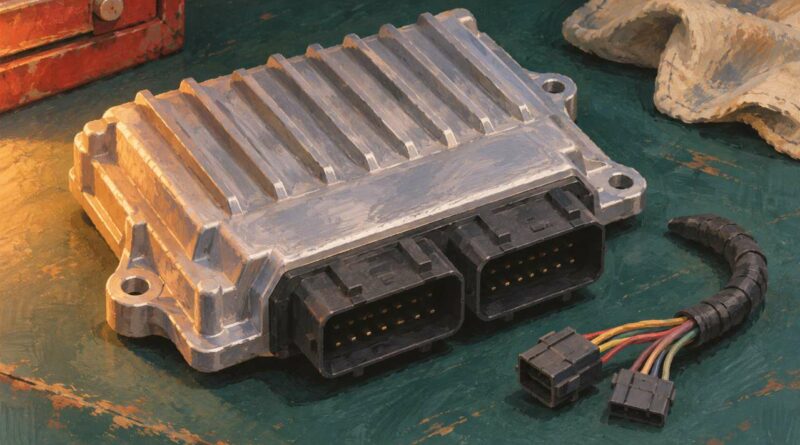
EMS means engine management system. ECU can mean electronic control unit generally, although people often use it to mean the engine control unit. The engine controller is one component within a wider arrangement that includes wiring, electrical supplies, sensors and actuators. Vehicles also have other control modules, so a reference to “the ECU” needs clarification.
Bosch describes its engine control unit as the central controller for engine management. Depending on the application, it coordinates air supply, fuel injection, ignition and exhaust treatment. That does not mean every vehicle has identical equipment or that every emissions component sits inside the same housing.
How sensors and actuators work together
Sensors provide information. Actuators carry out commands. The controller processes inputs against its programmed operating strategy and adjusts outputs as conditions change. A cold start, a warm idle and acceleration uphill require different decisions. Feedback from some sensors helps the controller check the result and make further adjustments within the system’s operating limits.
- Crankshaft and camshaft sensors provide information about engine speed and position.
- Temperature sensors help the controller account for conditions such as coolant temperature.
- Airflow or pressure measurements help assess engine load, depending on the design.
- Injectors deliver fuel under electronic control; petrol ignition systems also need timed sparks.
An accelerator-pedal sensor measures the driver’s request on relevant electronic systems. A throttle-position sensor reports throttle position. Those are related functions, but they are not interchangeable descriptions. DENSO’s engine-management component overview shows why it is more useful to understand each component’s role than memorise a generic list.
Petrol, diesel and hybrid systems differ
A petrol engine commonly controls spark timing alongside fuel delivery, while a diesel ignites injected fuel through compression. Both need appropriate management, but their components and diagnostic procedures differ. Turbocharging, direct injection and variable valve operation introduce further variations. A guide for one engine should not be treated as a parts checklist for another.
A hybrid with a combustion engine still needs engine management, coordinated with its other systems. A fully electric car has no combustion engine to manage in this sense. Its motor, battery and power electronics have their own controls. Keep that distinction in mind when reading broad claims about the “engine computer” in every modern car.
What an engine warning light actually tells you
An engine-management warning indicates that the vehicle has detected a relevant problem or condition. It does not identify the failed part by itself. Warning symbols, colours and instructions vary, so consult the correct handbook. Some lamps illuminate briefly during the normal start-up check; a lamp that remains illuminated or appears while driving needs interpretation.
If a warning flashes, the engine runs severely unevenly, or there is substantial power loss, stop the assessment and follow the vehicle’s instructions. Continuing a test drive can make a fault worse. Ford’s dashboard warning guidance illustrates why the precise warning and handbook advice matter. Never assume an amber symbol means unlimited safe driving.
Symptoms are clues, rather than a diagnosis
Difficult starting, unstable idle, hesitation, excessive fuel use and reduced performance can involve engine management. They can also involve mechanical condition, intake leaks, fuel supply or other faults. Several problems can produce similar symptoms, while an intermittent issue may disappear during a short viewing. A smooth idle alone cannot establish that everything is healthy.
For example, a petrol misfire might involve ignition, injection or compression. Replacing an engine controller because a car misfires skips essential diagnosis. My ignition-coil guide explains why a misfire code should not automatically become an instruction to fit a coil. The same evidence-led approach applies to other component claims.
What diagnostic codes can and cannot prove
A fault code records a condition detected by a control module. Its description may refer to a circuit, signal, performance issue or communication problem. The named component might be faulty, but wiring, connectors, power supply and related operating conditions can also matter. Reading codes is a useful starting point, rather than a complete diagnosis.
A competent workshop may compare live readings, examine wiring and carry out targeted tests using the manufacturer’s procedures. The necessary equipment and access vary. A basic reader might retrieve some engine-related information while missing functions available through suitable diagnostic equipment. A report should explain the scope of the scan instead of presenting “no codes” as a universal health certificate.
Why clearing a warning is not a repair
Clearing stored codes can remove useful evidence without addressing the cause. A fault may return immediately, under particular driving conditions or after further monitoring. Ask what happened before the reset and what tests established that the repair worked. A clear dashboard at handover is reassuring only alongside the wider evidence, not instead of it.
I would ask whether the vehicle can be viewed from cold and driven appropriately with permission and insurance. Note when symptoms occur, whether warning lamps behave normally, and whether the seller’s account matches invoices. Do not demand unsafe driving to reproduce a fault. An intermittent concern may need a workshop investigation beyond a pre-purchase assessment.
Questions to ask about an ECU replacement
An ECU replacement claim deserves a detailed explanation. Ask which unit was replaced, why it was condemned and how the replacement was matched to the vehicle. Depending on the model, coding, programming or security-related matching may be required. There is no universal plug-in solution, and a used controller is not automatically suitable because its casing looks identical.
- Request an invoice identifying the vehicle, work performed and supplying workshop.
- Ask whether the original cause, including any water ingress or supply problem, was addressed.
- Check whether subsequent warnings or starting difficulties have occurred.
- Seek clarification of any warranty and its terms before relying on it.
How this affects buying a used diesel
On a diesel, engine operation and exhaust treatment interact. A particulate-filter warning or regeneration problem needs its own investigation, including relevant engine faults. Repeated cleaning without understanding the cause may leave the buyer with the same problem. My DPF guide explains the distinction between soot, ash and the limitations of regeneration.
Do not confuse the particulate filter with the AdBlue system. They perform different jobs even where both are fitted. A seller’s claim that topping up a fluid fixes every emissions warning is too broad. Use the exact model’s instructions and obtain diagnosis when the warning or symptoms persist.
Can servicing or a software update prevent problems?
Following the correct service schedule supports the engine, but it cannot prevent every sensor or electrical fault. Use the specified fluids and replacement parts, and investigate symptoms rather than hoping a service will cure them. Fuel additives and premium fuel should not be offered as a universal answer to an unexplained warning.
Software updates can address particular issues where the manufacturer provides an applicable repair route. They are not a general cure for worn components or damaged wiring. Ask which update applies, why it is recommended and what checks come first. A seller saying the car “just needs an update” still needs evidence to support that conclusion.
Keep estimates specific to the registration, engine and diagnosed fault. A sensor replacement, wiring repair and controller replacement are different jobs with different labour and programming requirements. Compare written scopes, not isolated part prices. If the cause remains uncertain, request a diagnostic estimate before agreeing to a package of replacement components.
A current MOT is another piece of evidence with limits. The government’s MOT guidance explains that the test does not cover the condition of the engine, clutch or gearbox. Passing it does not establish that an intermittent running problem has been resolved. Read repair records alongside the test history. Neither a reset nor a test substitutes for diagnosis.
My practical buying decision
I would judge the car on its behaviour, history and available evidence, then identify what remains uncertain. A vehicle inspection can help assess accessible condition and highlight concerns within its agreed scope. It cannot guarantee that an intermittent electronic fault will appear or replace every manufacturer-specific diagnostic procedure.
Use my used-car buying checks alongside the engine assessment. If an unresolved warning affects the decision, ask for a written diagnostic conclusion and repair evidence before committing. Budgeting for an unproven “small fix” is a gamble. Clear explanations, consistent records and a properly verified repair are more useful than confident guesses.