The First Car Ever Made: How the Benz Patent-Motorwagen Changed Automotive History
As a vehicle inspector, I spend most of my working life looking at technology that motorists barely think about.
Electronic engine management, ABS, airbags, automatic transmissions, parking sensors and sophisticated suspension systems have become so normal that it is easy to forget how extraordinary the basic idea of a motor car once was.
Go back to the 1880s and there were no motorway services, petrol stations, diagnostic computers or nationwide networks of garages. There wasn’t even a mature road system designed around motor vehicles.
Yet an engineer in Germany was working on a machine that would help change transportation forever.
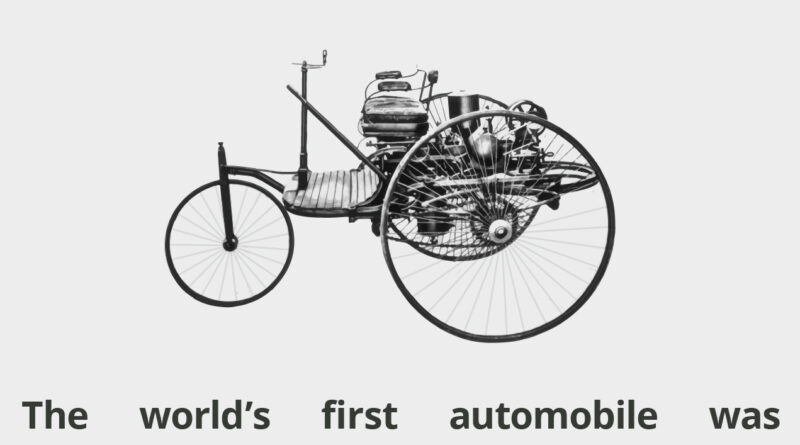
His name was Carl, or Karl, Benz, and the vehicle was the Benz Patent-Motorwagen.
The German Patent and Trade Mark Office describes Benz’s machine as the first functional automobile with a combustion engine. His patent application of 29 January 1886 is widely regarded as the birth certificate of the automobile.
For someone who spends his time inspecting modern cars, looking back at the Patent-Motorwagen is fascinating. Strip away 140 years of development and you can see the beginning of many engineering problems manufacturers are still solving today: propulsion, cooling, ignition, steering, braking, weight, reliability and getting power from an engine to the road.
Was the Benz Patent-Motorwagen Really the First Car Ever Made?
This needs some explanation because automotive history is more complicated than saying one person suddenly invented the car.
Self-propelled road vehicles existed before Benz. Engineers had experimented with steam propulsion, while electric vehicles would also become serious competitors during the early years of motoring.
What makes Benz’s invention historically important is that he created a functioning vehicle in which the chassis and internal-combustion engine were developed as an integrated motor vehicle.
The German Patent and Trade Mark Office identifies Patent No. 37435 as covering the first functioning motor vehicle integrating an engine with its chassis.
That distinction matters.
Benz was not simply taking a conventional horse-drawn carriage and swapping the horse for an engine. He was developing a machine around mechanical propulsion.
That is why 1886 is generally regarded as the birth year of the modern automobile.
Who Was Karl Benz?
Carl Friedrich Benz was a German engineer born in 1844.
His route to creating the automobile was not a simple story of an inventor having one brilliant idea and becoming instantly successful.
Like many engineering breakthroughs, it involved years of development, experimentation and financial uncertainty.
Benz worked extensively with engines before the Patent-Motorwagen appeared. By the end of 1879, Carl and Bertha Benz had succeeded in getting his two-stroke engine running. Bertha’s role should not be treated as a footnote either. She provided financial and practical support during difficult periods and later did something that arguably proved the automobile’s usefulness better than any engineering demonstration could.
We’ll come back to that journey shortly.
The Patent That Became the Automobile’s Birth Certificate
The date to remember is 29 January 1886.
On that day Benz filed his patent application for a “vehicle with gas engine operation”.
The patent became DRP 37435.
It is such an important document in technological history that UNESCO added it to its Memory of the World Register in 2011, describing it as a document of worldwide significance associated with the emergence and spread of individual motorised mobility.
The patent was later granted with effect from that January 1886 filing date.
By July 1886, newspapers were reporting on the first public outings of the three-wheeled Patent-Motorwagen.
Imagine seeing it at the time.
Road users were accustomed to horses, bicycles and carriages. Then along came a three-wheeled machine moving under its own power with an engine visibly operating at the rear.
Today it looks wonderfully primitive.
In 1886 it must have looked like the future had arrived early.
What Was the First Car Actually Like?
Place the Patent-Motorwagen beside a modern family hatchback and the difference is enormous.
There was no enclosed passenger compartment, steering wheel, heater, windscreen, infotainment system or conventional gearbox.
The basic layout consisted of a tubular structure with three wire-spoked wheels, a bench seat and an engine positioned at the rear.
The Patent-Motorwagen No. 1 used a single-cylinder, four-stroke petrol engine.
Its output was less than one horsepower.
That sounds almost comical when modern family cars routinely produce well over 100 horsepower and high-performance cars can produce many hundreds.
But horsepower figures alone miss the point.
Benz had created a machine capable of moving people without an animal providing the motive power.
From an engineering perspective, that was revolutionary.
How Did the Benz Patent-Motorwagen Work?
This is where the inspector in me becomes particularly interested.
A modern vehicle conceals most of its engineering beneath bodywork and electronic control systems. With the Motorwagen, much of the mechanical operation is visible.
The engine was mounted horizontally at the rear and used a large horizontal flywheel.
Starting it was certainly not a case of pressing a dashboard button.
The driver had to rotate the flywheel to start the engine before climbing aboard. A hand lever was then used to control movement, braking and stopping.
The vehicle used light petroleum fuel such as ligroin. Its working cylinder was water-cooled, and Benz’s patent also described a surface carburettor used to manage the mixture of fuel and air.
Its main engineering features included:
- A single-cylinder four-stroke engine
- Rear-mounted engine installation
- Water cooling
- A large horizontal flywheel
- Three-wheel configuration
- Tubular chassis construction
- Mechanical drive system
- Surface carburettor
- Electrically assisted ignition
- Hand-operated vehicle controls
These seem elementary today, but together they created something fundamentally new.
Why Did the First Car Have Three Wheels?
One of the most obvious differences is the three-wheel arrangement.
There was one wheel at the front and two at the rear.
This wasn’t simply Benz trying to make his invention look unusual.
Steering technology was a genuine engineering problem. A four-wheeled vehicle needs its front wheels to turn through different angles when cornering if it is to steer properly without excessive tyre scrub.
Benz chose a three-wheel configuration that simplified the steering arrangement while he developed his purpose-built motor vehicle.
At almost the same time, Gottlieb Daimler was following a different engineering route. In 1886, Daimler fitted an engine to a carriage, creating what is regarded as the world’s first four-wheeled automobile. Benz and Daimler worked independently of each other.
Their companies would eventually become connected through one of the most famous names in motoring.
The First Public Drive Did Not Immediately Change the World
It’s tempting to imagine Benz unveiling his invention to crowds who instantly realised they were witnessing history.
That isn’t what happened.
The German Patent and Trade Mark Office records a short public test drive of Benz’s No. 1 on 3 July 1886. Local newspapers reported on the invention, but public enthusiasm remained limited. Many people simply did not believe the “horseless carriage” was practical.
And you can understand why.
Horses were established technology.
They didn’t need petrol stations.
Blacksmiths, stables and supporting infrastructure already existed.
Benz wasn’t simply asking people to buy a new machine. He was introducing a completely different transportation system before the infrastructure needed to support it had been created.
Bertha Benz Proved the Car Could Actually Travel
This is one of my favourite stories in automotive history because it resembles the ultimate real-world vehicle test.
In August 1888, Bertha Benz took an improved Patent-Motorwagen and, without her husband’s prior knowledge, set off with her sons Eugen and Richard from Mannheim towards Pforzheim.
It was no short demonstration around a factory yard.
The outward journey was roughly 100 kilometres.
There were no roadside recovery services. There were no petrol stations. Roads were largely designed around horses and carriages.
During the journey, fuel was obtained from a chemist.
Bertha and her sons eventually reached Pforzheim after more than 12 hours. The journey demonstrated something critically important: the motor vehicle wasn’t merely an engineering experiment. It could provide practical personal transportation.
Including the return journey, Mercedes-Benz records the trip at around 180 kilometres.
In modern terms, you could think of it as an endurance test, customer trial and publicity campaign rolled into one.
What Bertha Benz’s Journey Taught Engineers
As an inspector, I particularly appreciate another aspect of this story.
Testing reveals weaknesses.
You can design a machine in a workshop and believe it works perfectly, but real roads introduce hills, vibration, heat, mechanical loads and unpredictable operating conditions.
Bertha’s journey provided exactly that sort of practical feedback.
It demonstrated where the vehicle worked and where improvements were required.
That principle hasn’t changed.
Manufacturers today spend enormous amounts of money testing vehicles in extreme heat, freezing temperatures, high altitudes, proving grounds and millions of miles of real-world driving.
And once those vehicles become used cars, an independent vehicle inspection serves a related purpose for the buyer. It looks beyond the specification sheet and asks the more practical question: how is this particular machine actually performing after years on the road?
The tools have changed enormously since Benz’s day, but mechanical reality still matters.
The Automobile Wasn’t Destined to Run on Petrol
Another misconception is that petrol cars appeared and immediately defeated every alternative.
Early motoring was far less settled.
Steam, electricity and petrol all competed.
German Patent and Trade Mark Office historical material notes that in the United States in 1900, around 40 per cent of automobiles were steam powered, 38 per cent were electric and only about 22 per cent used petrol.
That’s remarkable when viewed from the 20th century, when petrol and diesel engines became dominant.
It is even more interesting today as electric vehicles again become a major part of automotive development.
Automotive history rarely moves in a perfectly straight line.
From Less Than One Horsepower to the Modern Car
Look at what happened after Benz’s machine and the rate of development is extraordinary.
Cars gained:
- Four-wheel layouts
- Pneumatic tyres
- Multi-speed transmissions
- More powerful multi-cylinder engines
- Electric starters
- Hydraulic brakes
- Enclosed passenger compartments
- Windscreen wipers
- Heating and ventilation
- Seat belts
- Fuel injection
- Disc brakes
- Airbags
- Anti-lock braking
- Electronic stability control
- Engine management computers
- Hybrid powertrains
- Battery-electric propulsion
- Advanced driver-assistance systems
Modern vehicles can contain dozens of electronic control modules and millions of lines of software.
Yet the basic challenge remains recognisable.
You need to generate or store energy, convert that energy into controlled movement, transmit torque to the road, steer the vehicle and stop it safely.
Benz would recognise the purpose even if the technology surrounding it would appear almost unimaginable.
How Vehicle Inspection Evolved Alongside the Car
The earliest motor cars were machines for enthusiasts and engineers who frequently had to understand their own mechanics.
Modern motorists are in a very different position.
Cars have become dramatically safer and more reliable, but also substantially more complex.
When I conduct a car inspection today, I might be looking at mechanical wear, corrosion, tyres and fluid leaks just as an engineer would have done decades ago. But I can also be dealing with electronic fault codes, turbochargers, emissions equipment, sophisticated automatic transmissions, hybrid systems and numerous electronic modules.
That is why automotive progress has made professional inspection more important in certain respects, not less.
A modern used car can look excellent during a short test drive while still hiding expensive problems.
The principle I apply is straightforward: understand the machine before you commit your money to it.
Benz had to prove his machine worked.
Used-car buyers should do much the same with the vehicle they are considering.
Benz, Daimler and the Birth of Mercedes-Benz
Karl Benz wasn’t the only pioneer shaping the emerging motor industry.
Gottlieb Daimler and Wilhelm Maybach were simultaneously developing high-speed combustion engines and applying them to different forms of transportation.
Benz and Daimler worked independently and, according to Mercedes-Benz historical records, never personally met despite operating only around 130 kilometres apart.
Their businesses eventually became part of the same story.
Benz & Cie. and Daimler-Motoren-Gesellschaft later came together, creating the company behind Mercedes-Benz.
What began as competing experiments in a new form of transportation ultimately helped establish one of the world’s best-known automotive marques.
Where Is the First Car Today?
The original Patent-Motorwagen No. 1 survived.
According to the German Patent and Trade Mark Office, it was transferred to the Deutsches Museum in Munich on 13 March 1906 and remains on display at the museum’s Verkehrszentrum.
That makes it much more than a replica or reconstruction.
Visitors can stand in front of a physical machine directly connected to the beginning of the modern automotive age.
The patent itself has achieved similarly important historical status.
UNESCO’s inclusion of Patent DRP 37435 in its Memory of the World Register recognises that the significance of Benz’s work extends far beyond the motor industry.
Why the First Car Still Matters
From an inspector’s perspective, the most impressive part of the Patent-Motorwagen isn’t its speed or power.
By modern standards, both are tiny.
What matters is that Benz assembled a collection of engineering solutions into a workable transportation system.
Bertha Benz then helped demonstrate that the concept could function beyond a workshop or short demonstration run.
That combination of invention and real-world testing helped change transportation.
Cars subsequently reshaped:
- Where people could live
- How businesses transported goods
- How cities and roads were designed
- Personal travel and tourism
- Emergency services
- Manufacturing
- Motorsport
- International trade
- Employment
- Personal independence
The consequences were enormous, both positive and negative. Mass motoring increased personal mobility and economic connectivity, while also bringing road casualties, congestion, resource consumption and environmental consequences that engineers and policymakers continue trying to address.
Understanding automotive history means acknowledging both sides.
Final Thoughts
The answer to “Who made the first car?” sounds simple until you explore the history.
Inventors had experimented with self-propelled vehicles before Karl Benz, including steam-powered designs. Other engineers, notably Gottlieb Daimler and Wilhelm Maybach, were developing combustion-powered transportation at almost the same time.
But the Benz Patent-Motorwagen occupies a particular place in history.
Benz’s patent application of 29 January 1886 documented a functioning vehicle in which the combustion engine and chassis formed an integrated automobile. That is why the date is so widely treated as the birth of the modern car.
Then Bertha Benz did something equally important.
She took the idea onto real roads and demonstrated that an automobile could actually transport people over a meaningful distance.
Nearly 140 years later, I can inspect a modern car containing computers, airbags, cameras, turbochargers and technology Benz could never have imagined. But beneath all that complexity, the purpose remains remarkably familiar.
Build a machine capable of carrying people under its own power, make it controllable, make it reliable and prove that it works on the road.
The Patent-Motorwagen was where that automotive story truly began.
rming the way people travel and interact with the world. Understanding the origins and impact of the first car provides valuable insights into the evolution of automotive technology and the enduring legacy of innovation.