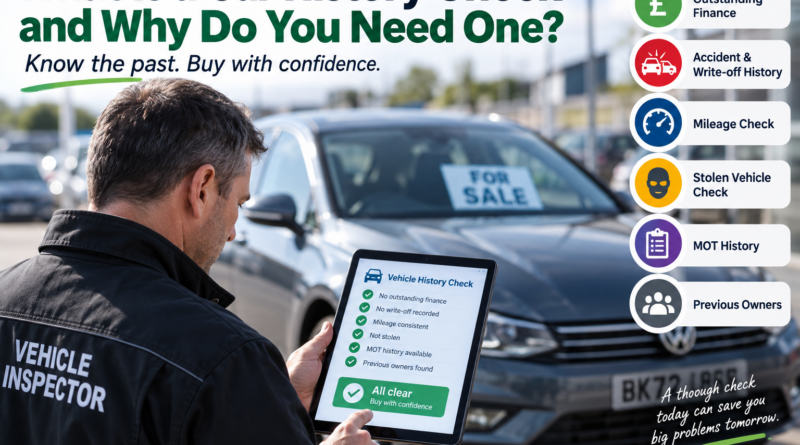
What Is a Car History Check and Why Do You Need One?
Buying a used car involves a certain amount of detective work.
As a vehicle inspector, I can examine what is physically in front of me. I can look for fluid leaks, accident repairs, worn brakes, tyre problems, suspension defects, warning lights, poor paintwork and dozens of other clues.
But there is something I cannot see simply by standing beside the car.
Its complete past.
A vehicle can look excellent and drive perfectly during a short test drive while still having outstanding finance recorded against it. It might previously have been declared an insurance write-off. Its current mileage might not fit its historical records. In a worst-case scenario, the vehicle’s identity itself may raise questions.
This is where a car history check becomes important.
I consider a history check and a physical inspection to be two different parts of the same used-car buying process.
One investigates the car’s recorded past.
The other investigates the vehicle sitting in front of you today.
You really want both.
What Is a Car History Check?
A car history check, sometimes called a vehicle history check, is a report compiled using information associated with a particular vehicle.
Depending on the provider and level of report purchased, it can search data relating to areas such as:
- Outstanding finance
- Insurance write-off history
- Stolen-vehicle records
- Mileage information
- Registration changes
- Number-plate changes
- Vehicle specifications
- Import or export information
- MOT history
- VIN information
- Previous keeper information or counts, where available
Not every provider includes exactly the same information, so always check what you’re actually buying.
There is also plenty of useful information available free of charge through official government services before you pay for a commercial report.
GOV.UK currently advises used-car buyers to compare the seller’s information with DVLA records, examine the MOT history, check for outstanding safety recalls and inspect the V5C registration certificate.
Think of a commercial history check as another layer of due diligence rather than a replacement for those checks.
What Does a Car History Check Tell You?
This is where the report starts earning its money.
Different providers have different datasets and coverage, but there are several areas I would want investigated before buying a used vehicle.
Outstanding Finance
This is one of the most important checks.
Many cars on UK roads are purchased using finance. There is nothing unusual about that.
The problem comes when somebody attempts to sell a vehicle while relevant finance remains outstanding without properly settling the agreement.
A private vehicle-history check can identify outstanding finance where the relevant information is available to the provider. Government consumer guidance specifically recommends checking this when considering a used vehicle.
If finance appears on a report, don’t simply accept:
“Don’t worry, I’ll pay it tomorrow.”
Establish exactly what type of finance is recorded, contact the relevant finance provider where appropriate and make sure the situation is properly resolved before proceeding.
A cheap car isn’t cheap if its ownership becomes a legal and financial headache.
Insurance Write-Off History
Cars involved in accidents or suffering other substantial damage can be declared total losses by insurers.
For vehicles assessed under the current salvage code, the categories you’re most likely to encounter are:
- Category A: Scrap only. The complete vehicle must be crushed.
- Category B: Break for parts. Certain usable components can be recovered, but the bodyshell must be crushed.
- Category S: Repairable vehicle that has suffered structural damage.
- Category N: Repairable vehicle that has suffered non-structural damage.
Categories S and N can return to the road when appropriately repaired.
And this is where buyers need to understand the limitation of a database.
A history report might tell me that a car was Category S.
It cannot, by itself, tell me whether the person who repaired it did an excellent job or a terrible one.
That’s a physical inspection question.
Why a Previous Write-Off Isn’t Automatically a Bad Car
I wouldn’t automatically reject every Category S or Category N vehicle.
Some are repaired to a good standard and priced accordingly.
But I would approach one differently.
I’d want to know:
- What was damaged?
- Who repaired it?
- Are photographs of the original damage available?
- Are repair invoices available?
- Were structural components involved?
- Has the geometry been checked?
- Are airbags and restraint systems correct?
- Does the asking price properly reflect the history?
A seller who is open about the previous damage and can document the repair gives you something to assess.
A seller who suddenly becomes vague when you mention the write-off marker gives you something else to assess.
Mileage History and Clocking
Mileage has a major influence on used-car value.
A five-year-old car showing 30,000 miles will normally be valued differently from an otherwise identical example showing 130,000.
That creates an obvious incentive for dishonest mileage alteration.
A history check can compare recorded mileage data from available sources and highlight inconsistencies.
You can also perform a useful first check for free.
The government’s MOT-history service displays the mileage recorded at previous MOT tests alongside pass and fail results.
Don’t panic over every discrepancy, though.
Data-entry mistakes happen.
DVSA even provides a formal process for correcting an incorrect mileage recorded during an MOT, which is why an anomalous entry should be investigated rather than automatically treated as proof of clocking.
What I’m looking for is whether the story makes sense.
If the car recorded:
42,000 miles
51,000 miles
59,000 miles
67,000 miles
and suddenly shows 38,000 miles today, I want an explanation.
Stolen Vehicle Records
This is another reason I wouldn’t buy first and check later.
Government consumer guidance recommends using a private vehicle-history check to establish whether a vehicle has been recorded as stolen.
But don’t stop with the database.
Look at the physical vehicle.
Check that the registration number, VIN and documentation correspond.
GOV.UK specifically advises buyers to examine the V5C, check its details and compare the vehicle identification number and engine number with the logbook.
If something doesn’t match, stop.
Don’t allow excitement about the car to override basic due diligence.
Check the VIN, Not Just the Registration Number
The Vehicle Identification Number is effectively the car’s unique identity number.
You’ll normally find it in several locations depending on the model, potentially including the windscreen area, body structure and manufacturer’s identification plate.
Compare it with the V5C.
I don’t like unexplained inconsistencies involving VINs.
Look for:
- Numbers that don’t match
- Evidence of tampering
- Damaged identification areas
- Suspicious plates or labels
- Documentation that doesn’t correspond with the vehicle
- Vehicle specification that differs significantly from the recorded identity
GOV.UK explicitly advises checking that the VIN and engine number correspond with the V5C when viewing a used vehicle.
What Can You Learn From MOT History?
The free MOT history is one of my favourite tools when assessing a used car.
Not because an MOT proves a vehicle is currently good, but because several years of test results can reveal patterns.
The official service can show:
- Passes and failures
- Recorded mileage
- Previous defects
- Minor defects
- Advisories
- Current MOT expiry information
For cars, motorcycles and vans, GOV.UK provides test results going back to 2005 where applicable.
I look for recurring themes.
Suppose a car repeatedly receives advisories for:
- Corrosion
- Worn suspension components
- Oil leaks
- Damaged tyres
- Brake deterioration
One advisory isn’t necessarily alarming.
But when the same issue appears year after year, I want to know whether it was actually repaired or merely survived until another MOT.
An MOT Is Not a Vehicle Inspection
This distinction matters enormously.
People sometimes tell me:
“It has 12 months’ MOT, so everything must be fine.”
That isn’t what an MOT means.
The MOT checks whether a vehicle meets prescribed road-safety and environmental standards at the time of the test.
It isn’t a comprehensive pre-purchase mechanical inspection.
An MOT doesn’t tell you whether the clutch is nearing the end of its life, whether the automatic gearbox behaves correctly under all conditions, whether the engine has an intermittent fault or whether a previous body repair meets the standard you’d expect for the asking price.
A fresh MOT is useful information.
It is not a warranty on the car’s condition.
What a Car History Check Cannot Tell You
This is probably the most important section of the entire article.
A history report checks recorded information.
It does not physically inspect the car.
A clean history check does not automatically mean:
- The engine is healthy
- The gearbox is good
- The clutch isn’t worn
- The suspension is sound
- There are no oil or coolant leaks
- The air conditioning works
- The tyres are good
- The brakes have plenty of life remaining
- The vehicle has never had cosmetic repairs
- Every previous accident or repair appears in a database
- The car has been maintained correctly
Databases only know what has been recorded and made available to them.
I can repaint a bumper tomorrow and a vehicle-history database isn’t going to inspect my paintwork.
That is why history and condition must be treated separately.
Why I Recommend a History Check AND Vehicle Inspection
If I were buying a used car, I would approach it in layers.
Layer one: identity
Does the VIN match? Does the registration correspond with DVLA records? Does the V5C make sense?
Layer two: recorded history
Finance, theft, insurance write-off information, mileage records and MOT history.
Layer three: documentation
Service records, invoices, maintenance history, recall work and evidence supporting the seller’s claims.
Layer four: physical condition
This is where a professional vehicle inspection becomes valuable.
An independent inspector can assess what the databases cannot see, including the current mechanical, structural and cosmetic condition of the actual vehicle you’re considering.
That combination is far more useful than relying on either approach by itself.
The V5C Is Important, But It Is Not Proof of Ownership
Another misunderstanding I regularly encounter concerns the logbook.
The V5C identifies the vehicle’s registered keeper. It should not be treated simply as proof that the person holding it legally owns the vehicle.
That is one reason finance checks, seller identification and purchase documentation matter.
DVLA itself advises buyers against purchasing a used vehicle that does not have a V5C.
When viewing the document, compare its information carefully with the physical car and official DVLA data.
Use the Free DVLA Information as Well
You don’t need to pay just to discover basic vehicle information.
The DVLA vehicle enquiry service can currently provide information including:
- Tax status
- SORN status
- MOT expiry
- First registration date
- Latest V5C issue date
- Year of manufacture
- Engine size
- Fuel type
- CO2 emissions
- Export status
All you need for the basic enquiry is the registration number.
The V5C issue date is particularly useful.
If the physical logbook presented by the seller doesn’t correspond with the latest record, I would investigate before handing over money.
What About an “HPI Check”?
You’ll hear people use the phrase “HPI check” as though it were the generic name for every car-history report.
Strictly speaking, it isn’t.
HPI is a commercial brand associated with vehicle-history checking. The generic terms are car history check, vehicle history check or similar descriptions.
It’s a little like people using a well-known brand name conversationally to describe a wider type of product.
For SEO and consumer clarity, I would use “car history check” throughout an informational article unless specifically discussing the HPI service itself.
Different commercial providers can offer vehicle-history reports, and their datasets, guarantees, prices and report contents can differ.
Compare what is actually included rather than buying purely on brand recognition.
How to Perform a Car History Check Properly
My process would look something like this:
- Get the registration number from the seller before travelling.
- Check the vehicle details through DVLA.
- Check the official MOT history.
- Check for applicable safety recalls.
- Purchase an appropriate commercial history report.
- Review finance, theft, write-off and mileage information.
- View the original V5C.
- Compare the VIN on the vehicle with the V5C.
- Review service history and invoices.
- Inspect the physical vehicle.
- Arrange an independent inspection where appropriate.
- Resolve every unexplained discrepancy before paying.
Notice that payment comes at the end.
Not halfway through.
Red Flags That Should Slow the Purchase Down
Used-car buying becomes risky when excitement creates urgency.
Slow down if:
- The seller refuses to provide the registration before viewing
- The VIN doesn’t match the V5C
- The seller cannot explain a mileage discrepancy
- Outstanding finance appears
- A write-off wasn’t disclosed
- The vehicle’s identity details don’t correspond
- MOT mileage suddenly decreases
- The latest V5C issue date raises unexplained questions
- The seller won’t allow an independent inspection
- The asking price is dramatically below comparable vehicles without a convincing reason
None of these should be solved by saying, “I’m sure it’ll be fine.”
Investigate.
What Should You Do If the History Check Finds Something?
It depends on what it finds.
Not every marker means you must automatically walk away.
A cherished-number transfer, for example, may explain a registration change perfectly.
A Category N or S vehicle may have been repaired correctly.
A mileage anomaly might be a documented MOT input error.
But some findings require much greater caution.
For outstanding finance, establish the exact position with the relevant finance company before proceeding.
For write-off history, inspect the quality of repairs and make sure the price reflects the vehicle’s past.
For mileage discrepancies, ask for invoices, service records and other dated evidence.
For unexplained identity or stolen-vehicle concerns, don’t proceed until the issue has been properly resolved.
The report should start questions, not end them.
Can a Clean History Check Guarantee a Good Used Car?
No.
And as an inspector, I think buyers need to hear that clearly.
A clean report means the provider hasn’t identified the problems covered by its report from the information available to it.
That’s valuable.
But it isn’t the same as saying:
“This car has never been damaged and has no mechanical problems.”
There can be unrecorded repairs. There can be developing mechanical faults. There can be poor maintenance. There can be cosmetic accident damage that never involved an insurer.
A database searches records.
An inspector examines a car.
You need to understand the difference.
The Inspector’s Used-Car Rule: Verify the Story
When I inspect a used vehicle, I’m effectively asking whether all the evidence tells the same story.
Imagine the advert says:
“One careful owner, low mileage, immaculate condition, fully maintained.”
Fine.
Now let’s verify it.
Does the history support the mileage?
Does the MOT record support the claimed maintenance?
Do the tyres look consistent with the mileage?
Does the paintwork suggest previous repair?
Do the service invoices make chronological sense?
Does the VIN match?
Does the diagnostic information raise concerns?
Does the physical wear inside the vehicle correspond with the claimed use?
Good used-car buying isn’t about trusting or distrusting every seller.
It’s about verification.
Final Thoughts
A car history check is one of the simplest pieces of protection available to a used-car buyer.
For relatively little effort, you can investigate important recorded information concerning finance, insurance write-offs, mileage and theft, while free government services can provide DVLA vehicle information and detailed MOT records.
But don’t make the mistake of thinking the report tells you everything.
It doesn’t.
A history check looks backwards through available records.
A car inspection looks at the vehicle that exists today.
For me, the sensible buying process combines both.
Check the registration. Read the MOT history. Compare the VIN. Examine the V5C. Investigate finance and write-off records. Review the maintenance paperwork. Then inspect the actual car properly.
When the documentation, history and physical vehicle all tell the same convincing story, you’re in a much stronger position to decide whether to buy.
And when they don’t, keep asking questions before you hand over your money.