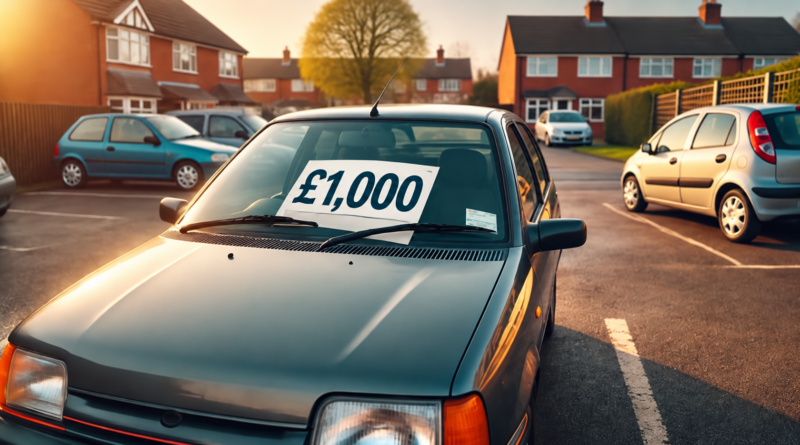
How to Buy a Car for £1,000: Used Car Inspector’s Guide
Can you still buy a usable car for £1,000?
Yes.
Can you simply open the classifieds, sort from cheapest to most expensive and buy the first car with a long MOT?
Absolutely not.
As a vehicle inspector, I approach the bottom end of the used-car market very differently from a three-year-old car sitting on a dealership forecourt.
At £1,000, perfection has left the conversation.
The car will probably be old. It may have high mileage. There will likely be scratches, dents, worn interior trim and evidence of previous repairs. You may find advisories on the MOT history and a folder containing invoices for parts you’ve never heard of.
None of that automatically makes it a bad car.
The question is whether the important parts are still fundamentally sound.
At this price level, I would rather buy an ugly but mechanically maintained car than a beautifully polished example hiding corrosion, overheating problems or a failing gearbox.
Your objective isn’t to find the perfect £1,000 car.
It is to find the least problematic car for your money.
Step 1: Set Realistic Expectations for a £1,000 Car
The first thing I’d tell any buyer is to forget the idea of finding a flawless bargain.
There is usually a reason a car costs £1,000.
The trick is finding a reason you can live with.
For example, I’d much rather hear:
“The paint is faded, the driver’s seat is worn and the air conditioning doesn’t work.”
than:
“It occasionally loses coolant but I’ve never worked out why.”
The first list is largely cosmetic.
The second sentence could potentially become expensive.
At this end of the market, expect:
- Higher mileage
- Cosmetic damage
- Scratched alloy wheels
- Worn interior trim
- Previous MOT advisories
- Some corrosion on older vehicles
- Age-related suspension wear
- Older tyres
- Incomplete service documentation
- Minor electrical faults
- Maintenance becoming due
The important distinction is between acceptable age-related wear and problems that threaten reliability, safety or the financial viability of the car.
A scratched bumper won’t stop you getting to work.
An overheating engine might.
Don’t Spend Your Entire £1,000 on the Car
This is probably my biggest piece of advice.
If £1,000 is your entire motoring budget, buying a car advertised for exactly £1,000 leaves you with no margin.
You still need to consider:
- Insurance
- Vehicle tax
- Fuel
- Immediate servicing
- Tyres
- Minor repairs
- Breakdown cover
- Unexpected faults
If possible, I’d rather buy an £800 car and keep £200 available than spend the full £1,000 and have nothing left when the battery fails the following week.
Realistically, an even larger repair reserve would be preferable.
Cheap cars don’t necessarily mean cheap motoring.
A £900 vehicle needing four tyres, front brakes and a cambelt can quickly become more expensive than a better-maintained £1,300 alternative.
Step 2: Buy Condition, Not Just a Particular Make
There is a common approach to cheap-car buying that goes something like:
“Just buy a Toyota.”
I understand the logic.
Certain manufacturers and models have strong reputations for reliability.
But at £1,000, I wouldn’t buy a car purely because of the badge.
A neglected Toyota can still be a bad purchase.
A carefully maintained Ford, Honda, Suzuki, Skoda or Vauxhall could potentially be the better car.
At this price point, individual condition becomes extremely important.
I would prioritise:
- Evidence of regular servicing
- Simple mechanical specification
- Affordable replacement parts
- Good availability of parts
- Sensible tyre sizes
- A healthy engine and gearbox
- Limited structural corrosion
- A decent MOT history
- A seller who can explain the car’s maintenance
I’d generally prefer mechanical simplicity.
An ordinary naturally aspirated petrol engine with a manual gearbox can sometimes present fewer expensive systems to worry about than a complex older diesel or sophisticated automatic, although every vehicle needs to be judged individually.
The key point is this:
Don’t buy a reputation. Buy the actual car in front of you.
Step 3: Search Widely and Be Prepared to View Several Cars
Finding a good £1,000 car usually requires patience.
You may need to view several vehicles before finding one worth buying.
Search across places such as:
- Auto Trader
- Facebook Marketplace
- Gumtree
- eBay
- Local classified advertising
- Community noticeboards
- Independent local sellers
Private sellers can sometimes offer good value because there is no dealer retail margin built into the price.
But private buying also means you need to perform your own due diligence carefully.
Don’t travel 100 miles because an advert contains the words “mint condition”.
Ask questions first.
Questions I Would Ask Before Travelling
A five-minute conversation can save you a wasted journey.
Ask:
- How long have you owned the car?
- Why are you selling it?
- What is the current mileage?
- Does it use oil or coolant?
- Does it overheat?
- Are there any warning lights?
- Does everything work?
- When was it last serviced?
- Has the cambelt been replaced if applicable?
- Are there any known faults?
- Is there service history?
- Do you have the V5C?
- Has it been involved in an accident?
- Can I see the car start from completely cold?
Listen to how the seller answers.
A genuine owner doesn’t necessarily know every mechanical detail, but they should normally know something about a car they’ve been driving.
Step 4: Check the History Before Viewing
For a £1,000 car, I wouldn’t spend hours travelling before doing the basic online checks.
Start with the registration number.
Check the vehicle’s information against DVLA records and examine its MOT history.
I’m particularly interested in the pattern of MOT results.
One failure doesn’t automatically worry me.
Cars fail MOTs.
What matters is why.
Look for recurring problems
Suppose you find this pattern:
2019: corrosion advisory
2020: corrosion advisory
2021: corrosion advisory
2022: corrosion becoming significant
2023: welding required
2024: further corrosion advisory
That tells me much more than simply seeing “MOT valid until November”.
Likewise, repeated advisories involving suspension, brake pipes, tyres or oil leaks deserve attention.
Mileage should also progress logically through the MOT history.
An unexplained reduction needs investigating.
Run a Car History Check
The term “HPI check” is often used conversationally, but HPI is a particular commercial brand. The generic term is a car history check or vehicle history check.
Depending on the service purchased, a history check may help identify:
- Outstanding finance
- Insurance write-off records
- Stolen-vehicle records
- Mileage discrepancies
- Previous registrations
- Other recorded history
Some buyers question whether paying for a history report makes sense on a £1,000 vehicle.
I think it can.
Losing a £1,000 car is still losing £1,000.
Check the V5C and VIN
When you view the car, ask to see the V5C registration certificate.
Compare the information with the vehicle.
Check the VIN physically displayed on the car against the documentation.
Don’t proceed casually if:
- VIN numbers don’t match
- The seller cannot produce the V5C
- The vehicle description differs from official records
- The identity appears to have been altered
- The seller’s story doesn’t make sense
A cheap purchase price doesn’t justify ignoring vehicle identity.
Step 5: Inspect the Car Properly
Now we’re into my territory.
With a £1,000 car, you need to separate cosmetic ugliness from expensive mechanical trouble.
Start with the engine cold
Ask the seller not to warm the engine before you arrive.
Put your hand near the bonnet carefully and establish whether the engine appears to have already been running.
A cold start can reveal:
- Starting difficulty
- Battery weakness
- Timing-chain noise
- Rough running
- Excessive smoke
- Engine rattles
- Warning lights
If you specifically asked for a cold engine and arrive to find it hot, ask why.
Check for Oil and Coolant Problems
Look underneath and around the engine bay for obvious leakage.
Check fluid levels correctly and safely.
I pay particular attention to coolant.
A £1,000 car that needs topping up with coolant every few days isn’t something I’d casually buy on the promise that “they all do that”.
Coolant loss can have several causes, some cheap and some potentially very expensive.
Also look for:
- Oil contamination
- Damaged hoses
- Poor repairs
- Loose wiring
- Heavy corrosion
- Missing components
- Signs of recent leakage being cleaned away
You aren’t trying to diagnose every fault on the driveway.
You’re deciding whether the car deserves further investigation.
Corrosion Matters More at This Price
Rust can be one of the biggest threats to the economic life of an older cheap car.
A worn battery can be replaced.
A damaged tyre can be replaced.
Serious structural corrosion can turn a cheap car into something no longer financially sensible to repair.
Look around accessible areas such as:
- Sills
- Wheel arches
- Suspension mounting areas
- Subframes
- Underbody
- Brake pipe areas
- Boot floor where visible
Surface corrosion on an old component isn’t automatically catastrophic.
Structural corrosion is different.
If you don’t know the difference, this is precisely where professional inspection becomes useful.
Check the Tyres Properly
Four cheap tyres can represent a significant percentage of a £1,000 car’s purchase price.
Check:
- Tread depth
- Sidewalls
- Cracking
- Bulges
- Uneven wear
- Tyre age where relevant
- Whether tyres match sensibly across each axle
Uneven wear can indicate more than a worn tyre.
It may point towards wheel alignment or suspension problems.
Look at the Interior
Don’t dismiss the interior because the car is cheap.
Interior wear can help you judge whether the claimed mileage and overall story make sense.
Check:
- Warning lights
- Heater
- Fan
- Electric windows
- Central locking
- Wipers
- Washers
- Lights
- Horn
- Instruments
- Seat belts
- Infotainment where relevant
At £1,000, I wouldn’t reject an otherwise excellent car because one speaker doesn’t work.
But warning lights for the engine, ABS or airbag deserve proper investigation.
Step 6: Take a Proper Test Drive
A stationary inspection only tells you part of the story.
Make sure you’re appropriately insured before driving.
Then give the vehicle enough time to reveal itself.
I’m paying attention to:
Engine
Does it accelerate smoothly?
Does it misfire?
Does the temperature remain stable?
Are there unusual noises?
Clutch
Does it engage smoothly?
Is the bite point excessively high?
Does it slip under load?
A clutch replacement can materially change the economics of a £1,000 purchase.
Gearbox
Every gear should select properly.
Listen for whining and watch for gears jumping out.
Steering
Does it pull to one side?
Is there excessive vibration?
Does the steering wheel return normally?
Suspension
Listen for knocks and rattles over rough surfaces.
Some noise on an old vehicle may be minor.
Repeated heavy knocking needs investigating.
Brakes
The vehicle should stop predictably without severe vibration, grinding or pulling.
Temperature
Don’t finish the test drive after two minutes.
If possible, allow the engine to reach normal operating temperature.
Some cooling-system and running problems only become apparent once the vehicle is warm.
A £1,000 Car Doesn’t Have to Look Good
This is where buyers sometimes spend their money in the wrong place.
Imagine two cars.
Car A
Beautiful paintwork, freshly polished, spotless interior.
But it has:
- Questionable coolant loss
- Cheap mismatched tyres
- Little service history
- Clutch beginning to slip
Car B
Scratched bumper, faded bonnet, stained driver’s seat.
But it has:
- Recent service
- Good tyres
- Evidence of cambelt replacement
- Healthy clutch
- No obvious fluid loss
- Sensible MOT history
For daily transport, I’d be far more interested in Car B.
Cosmetics can make a cheap car look undesirable.
Mechanical neglect can make it genuinely expensive.
Don’t Be Frightened of 100,000 Miles
I would change one important assumption from many cheap-car guides.
Crossing 100,000 miles doesn’t automatically make a vehicle a bad purchase.
Mileage matters, but maintenance matters more.
I’d rather inspect a 120,000-mile car with evidence of regular oil changes, recent brakes, a replaced cambelt and a careful owner than a neglected 70,000-mile example.
High mileage does increase the probability that components have worn, so you need to inspect accordingly.
But there is no magical cliff edge at 100,000 miles where a car suddenly becomes unusable.
Don’t Assume a 10-Year-Old Car Is Finished Either
The same applies to age.
A car doesn’t reach its tenth birthday and expire.
Age brings additional concerns, particularly corrosion, rubber deterioration, electrical problems and accumulated wear.
But condition varies enormously.
The older the vehicle, the more important the inspection becomes.
Judge the specific car rather than an arbitrary age limit.
Service History Can Be Worth More Than Shiny Paint
At £1,000, I love seeing invoices.
They tell a story.
Look for evidence of:
- Oil and filter changes
- Cambelt replacement where applicable
- Water pump replacement
- Clutch work
- Brake replacement
- Suspension repairs
- Battery replacement
- Tyres
- Exhaust repairs
- Cooling-system work
A stamped service book is useful, but invoices can sometimes tell you much more.
If the seller says, “I had the cambelt done last year”, ask for evidence.
Without evidence, budget as though it hasn’t been done.
When a Vehicle Inspection Makes Sense on a £1,000 Car
Some buyers think paying for a professional vehicle inspection makes no sense when the car itself only costs £1,000.
Look at it another way.
The purchase price isn’t your maximum possible loss.
You might buy the car for £1,000 and immediately discover it needs £700 worth of repairs.
Then you’re into the vehicle for £1,700.
An independent car inspection can help establish whether the engine, transmission, brakes, suspension, tyres, body structure and other major systems make the purchase worthwhile.
On very cheap cars, the purpose of an inspection isn’t to produce a long list of every minor imperfection.
There will be imperfections.
The useful question is:
Is there anything here that makes this £1,000 car a financially poor purchase?
That’s what I’d want to know.
Negotiate Based on Real Faults
Once you’ve inspected and driven the vehicle, decide what it is actually worth to you.
Don’t automatically offer £700 simply because the seller wants £1,000.
If it’s a genuinely good £1,000 car, somebody else may simply buy it.
Instead, negotiate around actual findings.
For example:
- Two tyres need replacing
- Service is overdue
- Battery is weak
- Brake pads are low
- MOT is nearly due
- Minor suspension repair is required
Be realistic.
A scratched bumper on a 15-year-old £1,000 car isn’t a £500 negotiating point.
Work Out the Real First-Year Cost
This calculation is more important than the asking price.
Suppose the car costs £1,000.
Then you discover it needs:
- £250 in tyres
- £200 service and maintenance
- £300 cambelt work
- £150 battery and minor repairs
Your £1,000 car has effectively become a £1,900 car before considering insurance, tax and fuel.
That doesn’t necessarily make it bad value.
But you need to know before buying.
Sometimes paying £1,400 for the better-maintained example is cheaper than buying the £900 “bargain”.
Insurance Can Destroy the Budget
Always get an insurance quote before purchasing.
Never assume an old, cheap car will automatically be cheap to insure.
Premiums depend on far more than vehicle value, including the driver, location, claims history, occupation, model and other risk factors.
For a younger driver in particular, annual insurance can easily cost more than the vehicle itself.
Get an actual quote using the exact registration where possible.
Check the Vehicle Tax Before Buying
Vehicle tax can also vary significantly between older cars.
Check the current rate for the specific vehicle before making your decision.
And remember that the seller’s existing tax does not transfer to you.
When DVLA is notified that the vehicle has changed keeper, the previous keeper’s tax is cancelled. You must tax the vehicle yourself before using it on the road.
Factor that into the purchase.
Complete the Purchase Properly
If you’ve found the right car, don’t abandon your checks because you’re excited.
Before handing over the money:
- Check the V5C
- Check the VIN
- Confirm the seller’s details
- Agree the price
- Obtain a written receipt
- Record the mileage
- Keep a copy of the advert
- Keep relevant messages
- Complete the keeper change
- Arrange insurance
- Tax the vehicle before driving away
A V5C identifies the registered keeper. Don’t treat possession of the document alone as absolute proof of legal ownership.
If something about the seller, identity or paperwork doesn’t make sense, resolve it before paying.
When I Would Walk Away From a £1,000 Car
Cheap doesn’t mean you have to accept everything.
I’d become particularly cautious around:
- Serious structural corrosion
- Persistent overheating
- Significant coolant loss
- Heavy engine knocking
- Major gearbox problems
- Severe clutch slip
- Multiple important warning lights
- VIN discrepancies
- Suspicious paperwork
- Outstanding finance
- Dangerous tyres combined with other neglect
- Serious brake problems
- Seller refusing a reasonable inspection
- Mileage history that cannot be explained
- Extensive poor-quality accident repair
A £1,000 car can have faults.
It shouldn’t have every fault.
The Inspector’s £1,000 Car Rule
If you remember only one thing from this guide, remember this:
Don’t look for the youngest car with the lowest mileage. Look for the best-maintained car with the fewest expensive problems.
At this price level, I would happily accept:
- Scratches
- Small dents
- Faded paint
- Worn seat fabric
- Old-fashioned specification
- High but credible mileage
in exchange for:
- A healthy engine
- A working gearbox
- Limited structural corrosion
- Safe brakes
- Good tyres
- Sensible maintenance history
- A straightforward seller
That’s the trade-off.
Final Thoughts: Can You Really Buy a Good Car for £1,000?
Yes, but patience becomes part of the purchase price.
The £1,000 end of the market isn’t where you buy perfection.
It’s where you search for remaining useful life.
Check plenty of adverts. Speak to sellers before travelling. Study MOT histories. Run appropriate history checks. Inspect cars in daylight. Start them from cold. Drive them properly and don’t allow a shiny exterior to distract you from mechanical problems.
Most importantly, be prepared to walk away.
You may have to view several cars before finding the right one.
That’s normal.
As an inspector, I’d rather see someone spend two weeks searching and buy a scruffy, mechanically sound £1,000 car than fall in love with the first polished example and spend another £1,000 fixing it.
At this budget, you’re not really hunting for a cheap car.
You’re hunting for the car that has enough good life left in it to justify your money.
Find that, and £1,000 can still buy useful transport.