How to Change the Registered Keeper on a V5C Log Book: Simple UK Guide
I’ve inspected plenty of used cars where the mechanical side of the purchase was straightforward, but the paperwork wasn’t.
The buyer has checked the car, agreed the price and transferred the money. Then somebody asks:
“What do we actually do with the log book?”
This is one part of buying or selling a car that you don’t want to leave until later.
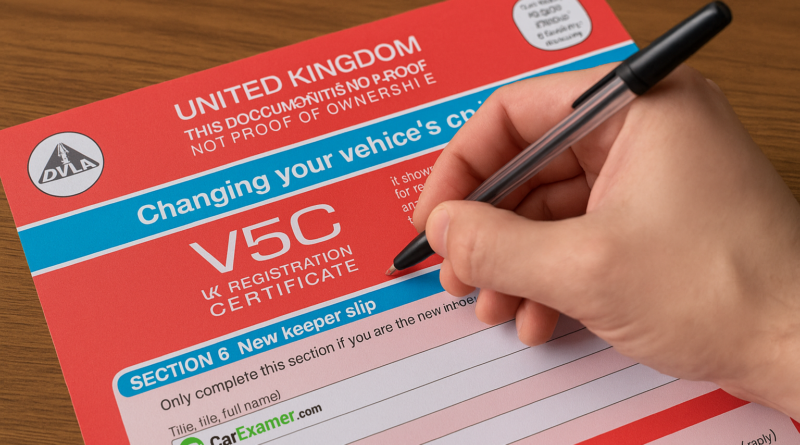
The V5C registration certificate, commonly called the log book, records the vehicle’s registered keeper with the DVLA. When a car changes keeper, the DVLA needs to be told.
Fortunately, if you have the V5C and the vehicle is staying in the UK, changing the registered keeper is normally a simple process. The seller can usually do it online while the buyer is standing there.
There is one important point to understand before we go any further:
The V5C is not proof of legal ownership.
That distinction matters, particularly when you’re buying a used car. Obtain proof of purchase when buying a used car.
What Is a V5C Log Book?
The V5C is the vehicle registration certificate issued by the Driver and Vehicle Licensing Agency, or DVLA.
It contains important information about the vehicle and its registered keeper.
Depending on the document and vehicle, you’ll find information such as:
- Vehicle registration number
- Registered keeper’s name and address
- Make and model
- VIN or chassis number
- Engine information
- Fuel type
- Colour
- Date of first registration
- Document reference number
When I’m looking at a used car for a buyer, the V5C is part of the paperwork I want to see.
But I don’t simply check that a V5C exists.
I compare it with the actual vehicle.
Registered Keeper and Owner Are Not Necessarily the Same Person
This is one of the most commonly misunderstood parts of the V5C.
The person named on the V5C is the registered keeper. That does not necessarily establish that they are the vehicle’s legal owner.
For many privately owned cars, the keeper and owner are the same person. But that isn’t always the case.
A company could own a vehicle while an individual is its registered keeper. A vehicle may also be subject to a finance arrangement where ownership needs to be considered separately.
That’s why I wouldn’t buy a car based solely on somebody pointing at their name on a V5C and saying:
“See, I own it.”
The V5C is an important part of the evidence, but it isn’t the whole ownership story.
When Do You Need to Change the V5C?
There are several situations where DVLA records may need updating.
These include:
- Selling a vehicle
- Buying a vehicle
- Giving a vehicle to another person
- Changing the registered keeper
- Moving home
- Changing your name
- Changing certain vehicle details
There are separate procedures for situations such as permanent export, scrapping and insurance write-offs, so don’t assume every V5C change follows the ordinary buyer-and-seller process.
Selling a Car: Who Changes the Registered Keeper?
If you’re the seller, don’t simply hand the entire V5C to the buyer and expect them to deal with everything later.
The seller is responsible for telling DVLA that the vehicle has been sold or transferred.
For a vehicle remaining in the UK, the seller should also give the buyer the green new keeper slip.
I prefer seeing this dealt with as part of the handover.
Money paid.
Receipt completed.
Keeper change submitted.
Green slip given to the buyer.
Keys handed over.
Everybody then knows exactly where they stand.
How to Change the Registered Keeper Online
For most ordinary private sales where the V5C is available, changing the keeper online is usually the simplest option.
Use the official DVLA service:
Tell DVLA you’ve sold, transferred or bought a vehicle
The service can be used to change the registered keeper and arrange for a V5C to be sent to the new keeper. At the time of writing, the online service operates Monday to Friday from 7am to 9pm and weekends from 7am to 8pm.
The seller will need the V5C and the buyer’s correct details.
Once the online notification has been completed, the seller should give the green new keeper slip to the buyer.
Don’t throw that slip away.
The buyer may need it before the replacement V5C arrives.
How Long Does a New V5C Take After an Online Keeper Change?
If a used vehicle is registered to its new keeper online by the seller, DVLA says the new V5C should normally arrive within 5 to 7 working days.
That is one reason I prefer the online process when it’s available.
When the new V5C arrives, don’t immediately file it away.
Check it.
Make sure the name, address and vehicle details are correct.
The New Keeper Must Tax the Car
This catches buyers out.
Vehicle tax does not transfer to the buyer when the vehicle is sold.
Once DVLA is notified of the sale, the previous keeper’s vehicle tax is cancelled and they receive a refund for any full remaining months where applicable. The new keeper must tax the vehicle before driving it, unless the vehicle is being kept off the public road and an appropriate SORN is made.
The green new keeper slip can be used to tax a newly purchased vehicle while you’re waiting for the new V5C.
That means buying a car at 4pm doesn’t give you the right to drive around using the seller’s remaining tax.
Sort your tax and insurance before using the car on the road.
Changing the Keeper by Post
You can still notify DVLA by post.
This is where older internet guides can cause confusion because they’ll often tell everybody to fill in “Section 6”.
That isn’t universally correct anymore.
For a new-style V5C with multi-coloured numbered blocks, the seller completes Section 2 when registering a used vehicle by post.
For an older-style V5C, the relevant keeper details are entered in Section 6, and the declaration in Section 8 must be signed as required. The seller gives the green new keeper slip to the buyer and sends the V5C to DVLA.
DVLA says a new V5C will usually arrive within four weeks when the vehicle is registered by post.
My advice is simple:
Follow the instructions printed on the V5C you actually have rather than relying on an old online article telling you a section number.
What Should the Buyer Check on the V5C?
This is where I put my inspector’s hat back on.
The V5C isn’t just something to complete after you’ve bought the car.
Check it before completing the purchase.
I want to compare:
- Registration number
- Make and model
- VIN
- Vehicle colour
- Keeper information
- Vehicle details
- V5C document details where appropriate
Most importantly, physically check the VIN on the vehicle.
Don’t just look through the windscreen and assume everything is correct.
Depending on the vehicle, VIN identification can appear in several places.
If the VIN on the vehicle and the documentation don’t agree, I wouldn’t carry on handing money over while hoping there’s an innocent explanation.
Investigate first.
Don’t Buy a Car Without a V5C Without Understanding the Risk
DVLA specifically advises buyers not to buy a vehicle that does not have a V5C.
That doesn’t mean every car missing its V5C is stolen or problematic. Documents get lost.
But as a buyer, you have to ask a very obvious question:
Why hasn’t the seller obtained a replacement before selling the car?
A missing V5C removes an important piece of documentation that you would normally use to verify the vehicle and complete the keeper change.
I’d want that resolved before treating the purchase as routine.
What If You’ve Bought a Car Without a V5C?
If you’ve already bought the vehicle without a V5C, the process changes.
DVLA says you’ll need to apply for a vehicle registration certificate using form V62. A £25 fee applies in the relevant circumstances.
If you’ve sold or transferred a vehicle without a V5C, you cannot simply use the normal online service. DVLA says the seller must write to them and provide details including:
- Seller’s name and address
- Registration number
- Make and model
- Exact date of sale
- New keeper’s name and address
That’s another reason to sort a missing V5C before advertising a car.
Lost Your V5C?
If you’re still the registered keeper and the V5C has been lost, stolen, damaged or destroyed, you can apply for a replacement.
Depending on the circumstances, applications can be made online, by phone or by post. If the V5C details need to change at the same time, a different process may apply.
Use the official service rather than one of the websites that imitates a government service and charges an unnecessary administration fee:
Get a replacement vehicle log book from DVLA
A replacement/new V5C application can cost £25 in the circumstances described by DVLA.
Moving House? Change the Address on Your V5C
A change of address isn’t a change of keeper.
You’re still the registered keeper, but DVLA needs your correct address.
You can normally change the address on a V5C online if you meet the eligibility requirements. DVLA says updating it is usually free.
You need:
- Vehicle registration number
- V5C reference number
- New UK address
And don’t assume changing your driving licence automatically updates the V5C.
They need to be dealt with appropriately.
DVLA states that you can be fined up to £1,000 if you fail to tell them when your name or address changes.
Change the address on your V5C
What If You’ve Changed Your Name?
You must also update the V5C if your name changes.
A name change currently follows a postal process. Depending on why your name changed, DVLA may require a letter explaining the change and supporting evidence.
DVLA says it can take up to six weeks to receive the replacement V5C following a name-change application.
If you’re changing your name and address at the same time, that also needs to be done by post.
This is another reason not to use one generic “change my log book” instruction for every situation.
The process depends on what you’re changing.
Selling Your Car? Protect the V5C
There’s a useful piece of current DVLA advice that sellers sometimes overlook.
A prospective buyer can inspect the V5C to confirm that the vehicle details match.
But DVLA warns sellers not to share photographs or copies of the V5C, or its document reference number, because those details could potentially be misused to obtain a fraudulent copy and put the vehicle at risk of theft or cloning.
So if somebody messages you before viewing and asks:
“Send me a clear photograph of every page of the log book.”
Don’t do it.
A genuine buyer can verify the appropriate documentation when viewing the vehicle.
The V5C Is Only One Part of Buying a Used Car
This is where paperwork and a vehicle inspection need to work together.
I’ve seen cars with perfectly ordinary-looking paperwork that still had serious mechanical or bodywork problems.
I’ve also seen buyers concentrate so heavily on the physical condition that they barely looked at the documents.
Neither approach is enough.
Before buying, I would combine:
- V5C checks
- VIN verification
- MOT history
- Vehicle history check
- Service history
- Outstanding finance checks where appropriate
- Recall information
- Physical car inspection
- Road test
A V5C tells you important information about the vehicle’s registration record.
It doesn’t tell you whether the clutch is worn, the engine is leaking oil, the suspension is knocking or the car has been badly repaired after an accident.
That’s the job of the physical inspection.
What I Check as an Inspector Before the Buyer Pays
When I’m inspecting a used car, I like the different parts of the car’s story to agree.
If the seller says the vehicle is a particular specification and mileage, the advert, V5C, VIN, MOT history, service records and physical car should support that story.
A few basic checks can prevent a much bigger problem later:
- Does the registration match?
- Does the VIN match the vehicle and paperwork?
- Does the mileage make sense against MOT and service records?
- Does the seller’s story agree with the documentation?
- Is the V5C available?
- Is the vehicle history consistent with what’s being advertised?
- Has the actual condition been checked?
If something doesn’t make sense, I don’t try to explain it away for the seller.
I investigate it.
Common V5C Mistakes to Avoid
The problems I see buyers and sellers create are usually avoidable.
Watch out for:
- Handing over the whole V5C without notifying DVLA
- Assuming the buyer will deal with the keeper change
- Assuming the seller’s road tax transfers with the car
- Driving away before taxing and insuring the vehicle
- Buying without seeing the V5C
- Failing to compare the VIN with the document
- Sharing photographs of the V5C online
- Forgetting to update the V5C after moving
- Assuming a V5C proves legal ownership
- Throwing away the green new keeper slip too early
- Ignoring a new V5C when it arrives instead of checking the details
My Simple Handover Checklist for a Used Car
If I were buying privately tomorrow, my final handover would look something like this:
- Complete my inspection and road test.
- Check the vehicle history, MOT history and paperwork.
- Compare the VIN with the V5C and vehicle.
- Agree the final price.
- Complete a written purchase receipt.
- Make payment using an agreed method.
- Have the seller notify DVLA of the keeper change.
- Take the green new keeper slip.
- Tax and insure the vehicle before driving it.
- Check the new V5C carefully when it arrives.
It’s not complicated.
The important part is doing it in the right order.
Final Thoughts
Changing the registered keeper on a V5C is usually one of the easier parts of buying or selling a used car.
If the seller has the correct V5C and the vehicle is staying in the UK, the online DVLA service can make the process straightforward.
But don’t treat the log book as meaningless paperwork.
For a buyer, it is part of verifying the identity and registration details of the vehicle you’re about to spend money on.
For a seller, notifying DVLA promptly helps establish that you are no longer the registered keeper and triggers cancellation of your vehicle tax.
And remember the distinction I regularly have to explain to buyers:
The V5C identifies the registered keeper. It is not, by itself, proof that the person named on it legally owns the car.
Check the paperwork, check the history and check the actual vehicle.