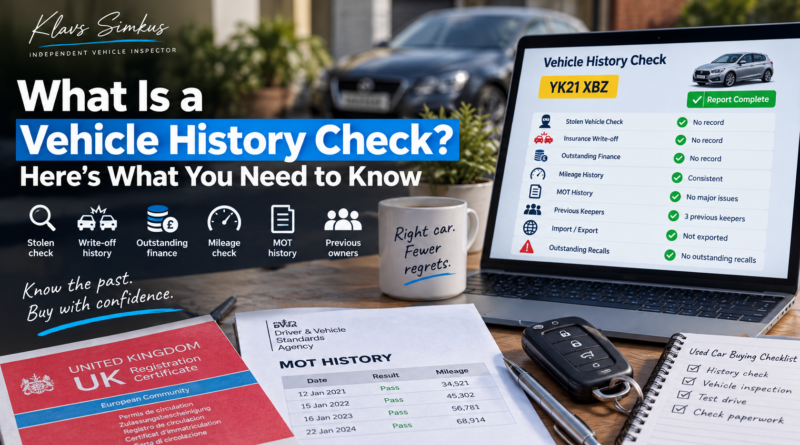
What Is a Vehicle History Check From Independent Inspector’s Perspective
When I inspect a used car for somebody, I want two different questions answered.
The first is: what has been recorded about this car in the past?
The second is: what condition is the car actually in today?
A vehicle history check helps with the first question. A physical inspection helps with the second.
Understanding that difference can prevent an expensive mistake.
I’ve seen buyers become confident because an online report came back “clear”. They understandably interpret that as meaning they’ve found a good car.
Unfortunately, a clean history report doesn’t tell me whether the clutch is worn, the engine is leaking oil, the gearbox is beginning to fail or the car has received poor repairs that were never recorded by an insurer.
A vehicle history check is still one of the first things I’d recommend when buying used. You simply need to understand what it can, and cannot, tell you.
What Is a Vehicle History Check?
A vehicle history check, also commonly called a car history check, investigates recorded information about a vehicle’s past.
You normally start with the registration number. Depending on the service and report you choose, information may then be gathered from several sources to identify important events or records associated with the vehicle.
A comprehensive check may investigate:
- Outstanding finance
- Recorded insurance write-offs
- Stolen-vehicle records
- Mileage discrepancies
- MOT history
- Registration changes
- Vehicle specifications
- Export information
- Scrapping records
- Keeper-related information
- VIN or vehicle identity information
The exact information available varies between providers, so always check what a particular report actually includes.
And remember one word: recorded.
A history check can only tell you about information available to the databases and sources being searched.
That limitation matters.
Why Should You Check a Used Car’s History?
Imagine you’re looking at a used car advertised for £12,000.
The paintwork looks excellent. The mileage appears reasonable. The seller tells you it has been well maintained.
None of those things answers three important questions:
Is there outstanding finance?
Has it previously been recorded as an insurance write-off?
Does its recorded mileage history make sense?
This is why I prefer buyers to investigate the vehicle before they become emotionally attached to it.
Current GOV.UK guidance recommends checking the vehicle’s details with DVLA, reviewing its MOT history and checking for safety recalls before purchase. When viewing the car, buyers should also check the V5C, VIN and engine number against the vehicle.
A history check adds another layer of due diligence to that process.
What Does a Vehicle History Check Include?
There isn’t one universal report containing exactly the same information.
Free government checks provide valuable official information. Commercial history providers can add further information, including finance, theft and insurance write-off records, depending on the service purchased.
These are the areas I pay particular attention to.
Outstanding Finance
Outstanding finance is one of the first things I’d want investigated before buying a used vehicle.
Cars are routinely purchased using finance. There is nothing unusual about that.
The problem arises when a vehicle is being sold while finance remains outstanding and the agreement hasn’t been properly dealt with.
If a history report identifies finance, don’t panic, but don’t ignore it either.
You need to establish:
- Which finance company is involved?
- What type of agreement is recorded?
- Is the agreement still active?
- How will it be settled?
- Will it be settled before or as part of the sale?
I wouldn’t simply accept a promise that:
“I’ll pay it off once you’ve transferred the money.”
When thousands of pounds are changing hands, verify the position properly.
Insurance Write-Off History
A comprehensive vehicle history check may reveal whether an insurer has previously recorded the car as a write-off.
The current UK categories are:
- Category A: the entire vehicle must be crushed
- Category B: the vehicle cannot return to the road, although some parts may be salvaged
- Category S: repairable vehicle that sustained structural damage
- Category N: repairable vehicle that sustained non-structural damage
Category S and Category N vehicles can return to the road after being repaired to a roadworthy condition.
That means discovering Category S or N history isn’t automatically the end of the conversation.
It changes the questions I ask.
Would I Buy a Category S or Category N Car?
Possibly. I would not buy category S cars due poor repair qualities. Cat N can be considered with pre purchase inspection.
But I would want to understand what happened to it.
When inspecting a previously written-off vehicle, the category on the history report is only my starting point.
I want to know:
- Where was the car damaged?
- How extensive was the damage?
- Are photographs available from before the repair?
- Who repaired it?
- Are there repair invoices?
- Was structural work involved?
- Does the current physical condition support the seller’s explanation?
Then I look at the actual car.
Panel alignment, paint finish, overspray, welding, underbody condition and suspension-related evidence can all help build a picture of the repair.
The important point is that a history check identifies the recorded event.
It doesn’t automatically tell you the quality of the repair sitting in front of you today.
Stolen-Vehicle Records
A suitable commercial history check can also help identify whether a vehicle has been recorded as stolen.
This is obviously something you want to discover before paying.
But I wouldn’t rely exclusively on an online report.
When I see the physical vehicle, I want its identity to correspond with the paperwork.
Check the VIN against the V5C and other available records.
If the VIN doesn’t match, don’t let anybody dismiss it casually.
Stop and investigate.
The registration plate is easy to see and easy to change. The vehicle’s underlying identity deserves more attention.
Mileage History and Clocking
Mileage affects how buyers perceive a car and how much they’re prepared to pay for it.
That creates an incentive for dishonest mileage manipulation, commonly called clocking.
One of the simplest checks available to UK buyers is the vehicle’s MOT history.
Previous MOT records can show mileage recorded at each test.
I’m looking for a sensible progression.
For example:
- 2019: 42,600 miles
- 2020: 49,800 miles
- 2021: 56,300 miles
- 2022: 63,100 miles
- 2023: 69,900 miles
Nothing there immediately concerns me.
Now imagine:
- 2019: 82,000 miles
- 2020: 89,000 miles
- 2021: 96,000 miles
- 2022: 61,000 miles
That deserves investigation.
A mileage discrepancy doesn’t automatically mean clocking
This is where buyers need to be careful.
Mistakes happen.
An MOT tester can enter the wrong mileage, and there is an official DVSA process for correcting MOT mileage errors where the required evidence can be supplied.
So I wouldn’t accuse somebody of clocking a vehicle solely because I found one inconsistent number.
Instead, I’d compare:
- MOT mileage
- Service records
- Repair invoices
- Previous advertisements where available
- Current odometer reading
- Physical wear
- Seller’s explanation
One strange number is a question.
Several unexplained inconsistencies become a much bigger concern.
MOT History Can Tell You More Than Pass or Fail
I use MOT history as an investigative tool.
Many buyers only look at the latest result:
PASS
Then they stop reading.
I scroll backwards.
Previous tests can reveal patterns that deserve attention.
For example:
- Recurring corrosion advisories
- Repeated tyre problems
- Oil leaks
- Brake deterioration
- Suspension wear
- Lighting faults
- Mileage inconsistencies
One advisory doesn’t necessarily worry me.
The same advisory appearing repeatedly over several years interests me considerably more.
Suppose corrosion is mentioned one year, appears again the following year and becomes more serious at the next test.
When I inspect that vehicle, I already know where I want to spend additional time.
That is how history information becomes useful during a physical inspection.
An MOT Is Not a Vehicle Condition Report
A seller tells you:
“It has a full year’s MOT, mate. There’s nothing wrong with it.”
I’ve heard variations of that many times.
A valid MOT is useful, but those two statements do not mean the same thing.
An MOT assesses prescribed road-safety and environmental requirements at the time of the test.
It isn’t a comprehensive assessment of the vehicle’s mechanical health or future reliability.
A car can have a valid MOT and still potentially have:
- Clutch wear
- Gearbox problems
- Engine faults
- Oil consumption
- Air-conditioning problems
- Battery deterioration
- Developing leaks
- Poor previous body repairs
- Overdue maintenance
So yes, check the MOT.
But don’t use it as a replacement for inspecting the car.
Previous Keepers
The number of previous keepers can provide context, but I wouldn’t judge a vehicle solely by that number.
A one-keeper car sounds attractive.
It could also have been neglected for ten years.
A five-keeper car sounds less desirable.
But those five keepers might all have serviced it correctly and repaired faults when necessary.
Maintenance and condition matter more.
Keeper information becomes particularly useful when it contradicts the seller’s story.
If somebody tells me:
“I’ve owned this car for seven years.”
I expect the available documentation and history to make sense alongside that statement.
If they don’t, I start asking questions.
Also remember that the registered keeper isn’t necessarily the legal owner. A V5C should not be treated as simple proof of ownership.
Registration Number Changes
Don’t panic simply because a vehicle has previously carried another registration.
Personalised registration numbers are routinely transferred on and off vehicles.
A plate change can therefore have a completely innocent explanation.
Historical registration information is useful because it can help connect records associated with the same vehicle.
As with most history information, the objective isn’t to treat every change as suspicious.
It’s to understand the explanation.
Check DVLA Vehicle Information
Before travelling to see a used car, I’d use the official DVLA vehicle enquiry service.
It can provide useful information including:
- Tax status
- SORN status
- MOT expiry
- Date of first registration
- Year of manufacture
- Engine size
- Fuel type
- CO2 emissions
- Export status
- Date the latest V5C was issued
That last item can be useful when you’re checking whether the V5C being shown to you corresponds with the current record.
This information is available from the registration number and costs nothing to check.
Don’t Forget Safety Recalls
Outstanding recalls are another area buyers sometimes forget.
The official government recall service allows you to check whether a vehicle has an outstanding safety recall.
This matters because recalls can involve important components or safety systems.
Recall work is normally carried out by the manufacturer or its authorised repair network without charging the owner.
It takes very little time to check, so I would include it in the buying process.
What a Vehicle History Check Cannot Tell You
This is probably the most important section of this guide.
A clean vehicle history report does not mean you’ve found a mechanically excellent car.
Imagine the report shows:
- No recorded outstanding finance
- No recorded theft
- No recorded insurance write-off
- Consistent mileage
Excellent.
Those are all encouraging findings.
But the vehicle could still have:
- A worn clutch
- Engine problems
- Gearbox faults
- Cooling-system problems
- Worn suspension
- Damaged tyres
- Electrical faults
- Poor maintenance
- Unrecorded accident repairs
There is another limitation buyers often overlook.
Not every accident becomes an insurance claim.
Imagine somebody damages a car and pays privately for the repair.
If the event never reaches the databases used by your history provider, the report cannot magically know that it happened.
That’s why I never use the phrase “clean history” to mean “perfect car”.
Vehicle History Check vs Vehicle Inspection
These two checks answer different questions.
A vehicle history check asks:
What has been recorded about this car?
A professional vehicle inspection asks:
What condition is the car physically in today?
During a pre-purchase car inspection, depending on the scope of the service, attention may be given to areas including:
- Engine
- Gearbox
- Clutch
- Steering
- Suspension
- Brakes
- Tyres
- Fluid leaks
- Bodywork
- Previous repair evidence
- Warning lights
- Electrical equipment
- Diagnostic faults
- Road-test behaviour
This is why I don’t consider a history report and physical inspection competing products.
They complement each other.
The report gives me background.
The vehicle gives me evidence.
What Should You Do If the History Check Finds Something?
A flagged history report doesn’t always mean you should immediately reject the vehicle.
It means you need to understand what has been found.
If it shows outstanding finance
Don’t proceed casually.
Establish the finance company’s details and determine how the agreement will be properly settled before ownership and payment arrangements are completed.
If it shows Category S or N history
Find out what happened.
Ask for photographs and repair documentation where available, then pay particular attention to the quality of the physical repair.
The previous write-off status should also form part of your valuation of the car.
If it shows a mileage discrepancy
Don’t immediately shout “clocked”.
Compare the discrepancy against MOT records, invoices and service history.
Ask the seller for an explanation and supporting evidence.
If it shows previous registration changes
Check whether personalised registration transfers explain them.
If the report is completely clear
Continue checking the car.
This last point matters.
A clear report should be treated as one positive part of your due diligence, not permission to stop investigating.
How I Check a Used Car Before Viewing It
Before I travel, I’d ideally obtain:
- Registration number
- Make and model
- Current mileage
- MOT details
- Basic service-history information
Then I’d:
- Check DVLA vehicle information.
- Review the complete available MOT history.
- Look at recorded mileage progression.
- Check for outstanding safety recalls.
- Run an appropriate commercial history check.
- Examine finance, theft and write-off information.
- Make a note of anything that needs physical verification.
This means I arrive already knowing something about the vehicle.
That’s much better than arriving completely blind and allowing the seller’s description to become your only source of information.
What I Check When I Reach the Car
Now the digital investigation meets the physical vehicle.
I want to see:
- V5C
- VIN
- Service book where available
- Service invoices
- Repair receipts
- Both keys where advertised
- Current mileage
- General condition
Then I compare everything.
Does the mileage make sense?
Does the VIN correspond?
Does the service history look plausible?
Does the physical wear correspond with the mileage?
Do previous repairs make sense alongside the recorded history?
Does the seller’s explanation agree with the evidence?
The answers don’t have to create a perfect story.
Used cars have histories.
But they should create a believable one.
Red Flags I Wouldn’t Ignore
Certain findings would make me slow the purchase down immediately:
- VIN doesn’t correspond with the documentation
- Seller won’t produce the V5C
- Unexpected outstanding finance
- Vehicle appears on stolen records
- Unexplained mileage reduction
- Seller’s story contradicts official information
- Previously undisclosed write-off history
- Poor repairs inconsistent with the seller’s explanation
- Suspicious or inconsistent service records
- Pressure to pay before reasonable checks are completed
One red flag doesn’t always prove dishonesty.
It means you need an answer.
If you can’t get a satisfactory answer, don’t allow excitement about the car to replace due diligence.
The Inspector’s Method: Make the Stories Match
When I’m investigating a used car, I think of it as four separate stories.
The seller’s story: What are they telling me?
The documentary story: What do the V5C, invoices and service records show?
The digital story: What do DVLA, MOT and commercial history records show?
The physical story: What does the actual car tell me?
The strongest purchases are generally the ones where those stories broadly agree.
Suppose an advert describes a vehicle as:
“Maintained regardless of cost.”
But the inspection finds badly worn tyres, overdue servicing, low fluid levels and several old MOT advisories that appear not to have been addressed.
The physical evidence doesn’t support the marketing description.
That’s useful information.
Conversely, an older high-mileage vehicle might have an enormous folder of maintenance invoices, a consistent MOT history and physical condition that supports the owner’s story.
That’s useful information too.
This is where experience becomes more valuable than simply ticking boxes.
Final Thoughts: Check the Past, Then Inspect the Present
A vehicle history check is one of the simplest ways to reduce your risk when buying a used car.
It can help uncover recorded information concerning finance, theft, insurance write-offs, mileage and other important aspects of a vehicle’s past.
But don’t allow a clear report to create false confidence.
Before buying a used car, I would combine:
- DVLA vehicle information
- MOT history
- Safety recall check
- Appropriate commercial vehicle history check
- V5C and VIN verification
- Service-history review
- Physical inspection
- Proper test drive
- Independent pre-purchase inspection where appropriate
A database tells you what has been recorded.
The paperwork tells you what has been documented.
The seller tells you their version of events.
The physical car tells you what you’re actually buying.
As an inspector, that’s the evidence I trust most when all the pieces are put together.
Check the history to understand the past. Inspect the car to understand its condition today.
Do both before your money changes hands.