Top 5 Used Car Buying Mistakes: An Inspector Explains What Buyers Get Wrong
Buying a used car isn’t Primark.
I sometimes wish more buyers approached the used-car market with that sentence in their heads.
When you buy an inexpensive shirt and later decide you don’t like it, the financial consequences are fairly small. A used car is different. You’re potentially putting thousands or tens of thousands of pounds into a complicated machine that somebody else has already driven, maintained, repaired, neglected, modified or occasionally abused.
You’re not buying new and cheap.
You’re buying second-hand, and you need to establish exactly what “second-hand” means for the particular car sitting in front of you.
As a vehicle inspector, I’ve seen buyers become emotionally committed to cars before I’ve even finished the inspection.
They like the colour. Their partner likes it. They’ve already imagined it parked outside their house. They’ve travelled two hours to see it and don’t want the journey to have been wasted.
Then I start finding problems.
Oil leaks.
Worn tyres.
Poor accident repairs.
Suspension problems.
Diagnostic faults.
A questionable service history.
Suddenly, the decision becomes much more difficult because emotionally they’ve already bought the car.
The safest used-car purchases tend to happen when buyers do the opposite.
Investigate first.
Decide second.
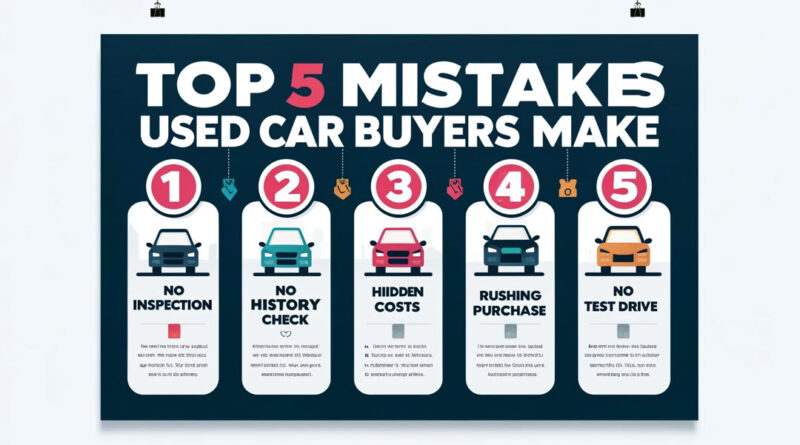
Here are five mistakes I repeatedly see used-car buyers make, and how I’d avoid them.
Mistake 1: Skipping the Pre-Purchase Inspection
This is probably the mistake closest to my own work.
A buyer finds a car online.
The photographs look fantastic.
The advert says:
“Excellent condition.”
“Drives perfectly.”
“First to see will buy.”
“Mechanically faultless.”
The buyer arrives, walks around it for ten minutes, starts the engine and decides everything sounds fine.
Money changes hands.
A week later, the problems begin.
A shiny car isn’t necessarily a healthy car
Presentation is powerful.
Freshly washed paintwork, tyre dressing and a clean interior can create an immediate impression that a vehicle has been cared for.
Sometimes that’s true.
Sometimes it isn’t.
When I inspect a used car, I’m not judging how effectively it has been prepared for sale. I’m trying to establish its actual condition.
Depending on the vehicle and inspection service, that can involve looking at:
- Engine condition
- Oil and coolant leaks
- Cooling system
- Transmission operation
- Clutch condition
- Steering
- Suspension
- Brakes
- Tyres
- Bodywork
- Evidence of previous accident repairs
- Warning lights
- Electrical equipment
- Diagnostic information
- Road-test behaviour
None of those becomes irrelevant because the paint has just been polished.
A professional inspection doesn’t mean finding a perfect car
This is another misconception.
Some buyers think the purpose of a pre-purchase inspection is to find a used car with absolutely nothing wrong with it.
That’s unrealistic.
Every used vehicle has a history and some degree of wear.
My job as an inspector is to help separate normal age-related deterioration from issues that could affect safety, reliability, value or your future repair budget.
A five-year-old car with a few stone chips is normal.
A five-year-old car with poor structural repairs, warning lights and a gearbox problem is a very different proposition.
Why refusing an inspection matters
If a seller doesn’t want an independent vehicle inspection, ask why.
There can occasionally be practical reasons involving location, insurance or timing, so refusal isn’t automatically proof that somebody is hiding something.
But I wouldn’t simply ignore it.
If I’m spending serious money and the seller won’t allow reasonable independent checks, I’d be prepared to find another car.
There are thousands of used cars for sale.
You only need one good one.
Mistake 2: Not Checking the Vehicle’s History
The second mistake is treating the physical car as the entire story.
It isn’t.
A car has two conditions.
There is the condition I can physically inspect today.
Then there is its recorded history.
You need to investigate both.
Start with the free MOT history
The official MOT history can tell you considerably more than whether the car currently has an MOT.
You can review previous test results and recorded mileage, as well as defects and minor problems where applicable.
I use that history to look for patterns.
Imagine a car repeatedly showing advisories involving:
- Corrosion
- Oil leakage
- Suspension wear
- Brake deterioration
- Tyre damage
If the same problem appears repeatedly, I want to know whether it was eventually repaired.
Mileage should also progress logically.
A strange reduction doesn’t automatically prove clocking because recording errors can happen, but it certainly deserves investigation.
Run a proper car history check
For a substantial purchase, I would also consider an appropriate commercial vehicle history report.
Depending on the provider and package, this may help identify information concerning:
- Outstanding finance
- Insurance write-off records
- Stolen-vehicle records
- Mileage discrepancies
- Registration changes
- Other recorded vehicle history
People often call any such report an “HPI check”, but HPI is a particular commercial brand. “Car history check” or “vehicle history check” is the more generic description.
Check the car’s identity
Don’t simply enter the registration into a website and consider the job finished.
When you physically see the car, compare its identity with the documentation.
Look at the V5C and check the VIN.
The registration, make, model, VIN and other relevant details should tell a consistent story.
If something doesn’t correspond, stop and investigate.
Never allow a seller to hurry you through an identity discrepancy because “it’s probably just paperwork”.
Paperwork is part of what you’re buying.
Mistake 3: Treating the Test Drive as a Formality
I’ve seen buyers test-drive a car for five minutes around an industrial estate and consider that sufficient.
It isn’t.
A test drive has two purposes.
First, you’re checking whether you actually like the car.
Second, you’re giving the vehicle an opportunity to reveal problems that weren’t obvious while stationary.
Make sure you’re properly insured to drive the vehicle before starting.
Start with the engine cold where possible
If I’m inspecting a car, I generally prefer seeing how it behaves from cold.
Cold starting can reveal:
- Battery weakness
- Starting problems
- Timing-related noises
- Rough idle
- Smoke
- Engine rattles
- Warning lights
Once an engine has been warmed up, some symptoms can become less obvious.
If you’ve specifically asked the seller not to start the vehicle before you arrive and you find the engine hot, ask why.
Don’t just check whether it moves
During the drive, pay attention to the whole vehicle.
Engine: Does it accelerate cleanly? Is there hesitation, smoke or unusual noise?
Manual gearbox: Do all gears select properly? Is there excessive noise?
Automatic gearbox: Does it engage Drive and Reverse properly? Are shifts smooth and consistent?
Clutch: Does it slip? Is engagement sensible?
Steering: Does the car pull? Is the steering wheel reasonably straight? Are there vibrations?
Suspension: Are there knocks, clunks or rattles over uneven surfaces?
Brakes: Does it stop predictably without severe vibration, grinding or pulling?
Temperature: Does the engine reach and maintain its expected operating temperature?
Some problems only become apparent once the car has been driven for a while.
A two-minute journey may tell you almost nothing.
The car also needs to suit you
A mechanically good car can still be the wrong purchase.
Ask yourself:
- Is the driving position comfortable?
- Can I see properly?
- Is the ride acceptable?
- Is there enough space?
- Can I live with the gearbox?
- Is it suitable for my normal journeys?
Don’t spend £10,000 on a car you don’t actually enjoy driving simply because you’ve already travelled to see it.
Mistake 4: Looking at the Purchase Price Instead of the Ownership Cost
This catches buyers constantly.
They say:
“My budget is £8,000.”
Then they find a £7,995 car.
That isn’t necessarily an £8,000 decision.
It’s an £8,000 purchase followed by insurance, tax, servicing, tyres, fuel and repairs.
Sometimes the cheaper car is the more expensive one.
Work out what the vehicle needs next
Imagine two otherwise similar cars.
Car A costs £7,500
But it needs:
- Four tyres soon
- A major service
- Front brakes
- Air-conditioning repair
Car B costs £8,000
But it has:
- Four recent quality tyres
- Recent servicing
- New brakes
- Evidence of preventative maintenance
The £500-cheaper car isn’t automatically the better deal.
This is why condition matters.
Insurance needs checking before purchase
Never assume that because you can afford the vehicle, you can comfortably insure it.
Get a quotation for the specific model, and preferably the specific registration, before committing.
A surprisingly high premium can completely change the economics of the purchase.
Think about tax and fuel
Older vehicles with larger engines can sometimes carry substantial running costs.
Likewise, a cheap diesel isn’t necessarily a sensible choice for somebody who mostly completes short urban journeys.
Think about how you’re actually going to use the vehicle.
Research known maintenance requirements
Before buying a particular model, investigate its maintenance schedule and typical age-related problems.
Questions worth asking include:
- Does it have a timing belt?
- When is replacement due?
- Is there evidence it has been changed?
- Does the gearbox require scheduled servicing?
- Are the tyres unusually expensive?
- Are replacement parts readily available?
- Are there known age-related issues worth checking?
This isn’t about finding a car that can never go wrong.
Such a car doesn’t exist.
It’s about understanding your likely financial exposure before committing.
Mistake 5: Falling in Love With the Car and Rushing the Purchase
This may be the biggest mistake of all because it makes the other four more likely.
The buyer sees the car and immediately decides:
“This is the one.”
From that point onwards, every piece of evidence gets interpreted in favour of buying it.
Oil leak?
“Probably minor.”
Worn tyres?
“I’ll replace them eventually.”
Strange gearbox noise?
“They said it’s normal.”
Poor MOT history?
“But look at the colour.”
That’s not inspection.
That’s confirmation bias.
Don’t let artificial urgency make the decision
Used-car adverts often contain phrases designed to create urgency:
“Won’t be here long.”
“First to see will buy.”
“Lots of interest.”
“Someone else is coming tonight.”
Maybe that’s completely true.
It still doesn’t change the condition of the car.
If another buyer purchases it while you’re carrying out reasonable checks, let them.
Missing one used car is considerably cheaper than buying the wrong one.
Be careful with deposits
If you are considering leaving a deposit while checks or an inspection are completed, establish the terms before paying.
Don’t simply assume every deposit is automatically refundable.
Get the conditions in writing.
For example, if your agreement is that the deposit will be refunded if an independent inspection identifies specified significant faults, make sure both sides clearly understand and document that condition.
Ambiguity is your enemy.
Negotiate with evidence
Buyers often believe negotiation means choosing an arbitrary lower number.
It doesn’t.
The best negotiation is evidence-based.
Suppose the asking price is £9,000 and the inspection identifies:
- Two tyres requiring replacement
- A service overdue
- Front brake wear
- A damaged alloy
- A minor suspension defect
Now you have facts.
You can calculate the likely costs and decide what the car is worth to you.
A professional car inspection can therefore help with more than deciding whether to buy. It can give you a clearer basis for discussing price or asking the seller to rectify specific defects before completion.
But don’t assume every seller must negotiate.
If a good car is correctly priced, paying the asking price may be entirely reasonable.
Bonus Mistake: Thinking an MOT Means the Car Is Mechanically Excellent
I see this often enough that it deserves its own section.
The seller says:
“Don’t worry, it has 12 months’ MOT.”
That’s useful.
It isn’t a guarantee of mechanical condition.
An MOT assesses prescribed road-safety and environmental standards at the time of the test.
It isn’t the same thing as a comprehensive pre-purchase inspection.
A vehicle can have a valid MOT and still potentially have:
- A worn clutch
- Developing gearbox problems
- Oil leaks
- Air-conditioning faults
- Poor cosmetic repairs
- Electrical problems
- Service items becoming due
- Mechanical problems outside the MOT’s scope
So check the MOT.
Study its history.
But don’t treat an MOT certificate as a warranty for the whole vehicle.
Bonus Mistake: Not Checking for Outstanding Safety Recalls
This is an easy check and one buyers sometimes forget.
Before buying, check whether the vehicle has an outstanding safety recall.
Recalls can involve important safety components, and depending on the issue, manufacturers normally carry out recall work without charging the vehicle owner.
It’s another piece of the due-diligence puzzle.
My Used-Car Inspection Routine
When I’m looking at a vehicle, I’m trying to make several separate stories agree.
The seller’s story
What are they claiming about the car?
The documentary story
What do the V5C, service invoices and maintenance records say?
The digital story
What do MOT records, history checks and diagnostic information tell us?
The physical story
What condition is the actual vehicle in?
When all four broadly agree, that’s encouraging.
When they contradict one another, that’s when I start asking more questions.
For example, imagine a seller describes a vehicle as:
“Meticulously maintained, no expense spared.”
Then I find four poor tyres, overdue servicing, low fluid levels and MOT advisories that have appeared repeatedly without being addressed.
The physical evidence doesn’t support the description.
That’s useful information.
A Used Car Isn’t Primark
This is the point I want buyers to remember.
You’re not walking into a shop and choosing a new product from a rack.
Every used car is different.
Two cars can be:
- The same model
- The same year
- The same colour
- The same specification
- Similar mileage
and still be completely different purchases.
One may have been serviced properly, driven sympathetically and repaired whenever necessary.
The other may have spent years running on the cheapest tyres, missed oil changes and undergone poor accident repairs.
That’s why shopping purely by age, mileage and price doesn’t work.
You’re buying the individual vehicle.
Its history matters.
Its condition matters.
Its previous maintenance matters.
And what it is likely to cost you next matters.
The Inspector’s Used-Car Buying Checklist
Before committing, I would want to answer these questions:
- Does the car’s identity match its paperwork?
- Does the MOT history make sense?
- Has the recall status been checked?
- Has an appropriate vehicle history check been completed?
- Is there outstanding finance?
- Is there recorded write-off history?
- Does the mileage appear consistent?
- Does the service history support the seller’s claims?
- Has the vehicle been physically inspected?
- Has it been properly test-driven?
- Are there warning lights or diagnostic concerns?
- What maintenance is due next?
- What condition are the tyres and brakes in?
- Are there signs of previous accident repairs?
- Have I checked insurance and tax costs?
- Can I comfortably afford foreseeable repairs?
- Am I buying because the evidence is good, or because I’ve fallen in love with the car?
That final question catches more people than you might imagine.
Final Thoughts: Inspect First, Fall in Love Later
Used cars can represent excellent value. But the saving compared with buying new only matters if you buy the right vehicle:
- Don’t trust an advert simply because it sounds convincing.
- Don’t assume a shiny car is mechanically healthy.
- Don’t skip the history check. Don’t treat the test drive as a lap around the block.
- Don’t calculate affordability using the purchase price alone.
And most importantly, don’t allow excitement to make the decision before the evidence does. I’ve inspected enough used cars to know that there will always be another one for sale. Walking away from a questionable vehicle isn’t losing an opportunity. Sometimes it’s the most profitable decision you’ll make during the entire buying process.
- Check the history.
- Inspect the car.
- Drive it properly.
- Understand the costs.
- Negotiate from evidence.
- Then make your decision.
Because buying a used car isn’t shopping in Primark. You aren’t buying something new and cheap. You’re buying a car somebody else has already lived with, and your job is to find out exactly what they are handing over.